Archives for category: Photography

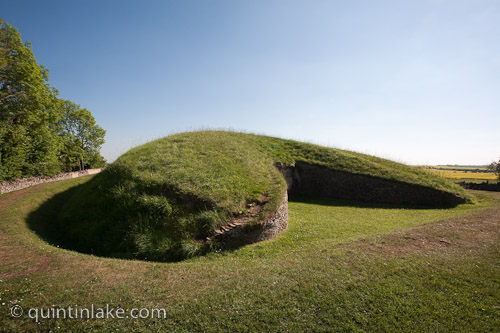
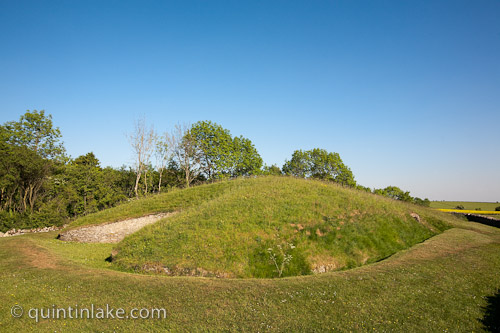
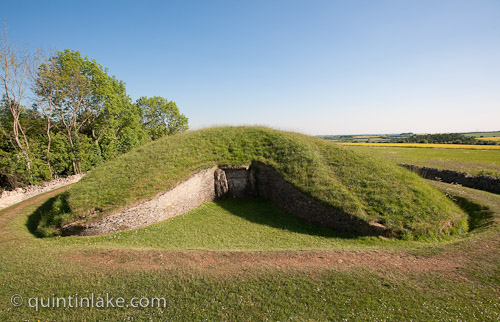
Belas Knap neolithic long barrow, Northern False Portal

Belas Knap is a neolithic long barrow, situated on Cleeve Hill, near Cheltenham and Winchcombe, in Gloucestershire, England. It is in the care of English Heritage. “Belas” is possibly derived from the Latin word bellus, ‘beautiful’, which could describe the hill or its view. “Knap” is derived from the Old English for the top, crest, or summit of a hill.

Belas Knap neolithic burial mound , Northern False Portal at left with Western Chamber just visible at right

What appears to be the main entrance to the barrow, with intricate dry-stone walling and large limestone jambs and lintels is, in fact, a false one. The actual burial chambers are down the long East and West sides of the barrow and at its Southern foot. There are four burial chambers, two on opposite sides near the middle, one at the South-East angle and one at the South end. These are formed of upright stone slabs, linked by dry-stone walling and originally had corbelled roofs.

Belas Knap neolithic long barrow, Northern False Portal from 4m high vantage

This northern end measures about 26 metres wide and the barrow then tapers towards the south where it measures 17 metres in width and less than a metre in height. The whole of this trapezoid mound is around 70 metres in length.

VIEW MORE IMAGES/ BUY PRINTS / LICENCE photographs of Belas Knap here

Text from wikipedia article
Photography © Quintin Lake, 2010

Tarmac lay-by, Yellow fields, Buzzing pylons, Sliced landscape, Bench with a view, Rolling landscape, Mobile phone tree, Farmer fixing fence, £25 for a sheep, Carved gatepost, Dandelion field, Mendip sunset

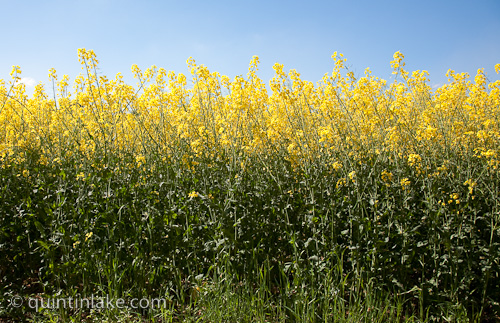
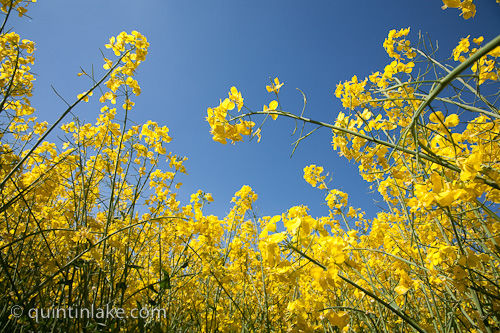
Looking up at the edge of field of yellow rapeseed in flower (canola) showing stems and flowerhead under a blue sky on a sunny day. Seven Springs, Gloucestershire, England.

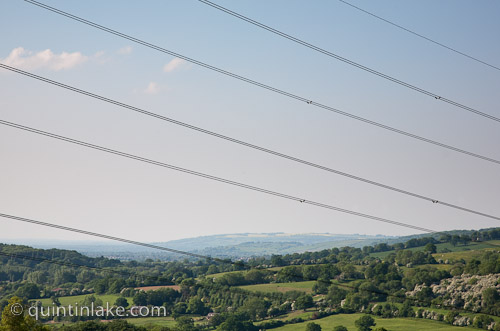
Overhead power lines diagonally cross the Cotswold landscape of rolling hills and fields Ravensgate Hill in Gloucestershire, England.

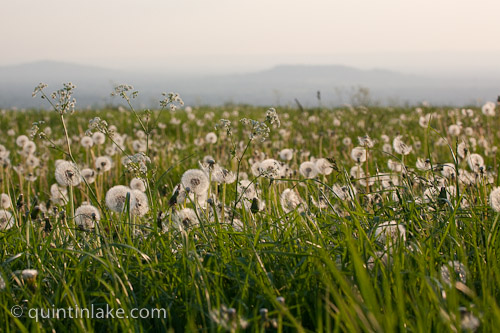
Meadow of Dandelion (Taraxacum) and Cow parsley (Anthriscus sylvestris). Half seeded dandelion clock and parachute balls with Chosen Hill (R) and Nut Hill (L) visible in the distance Gloucestershire.

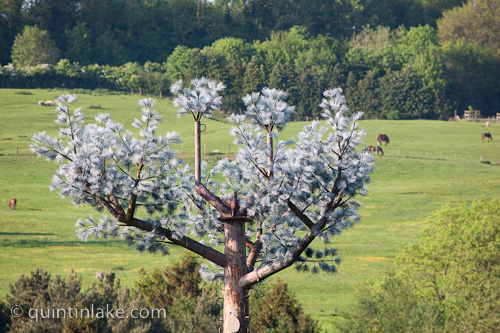
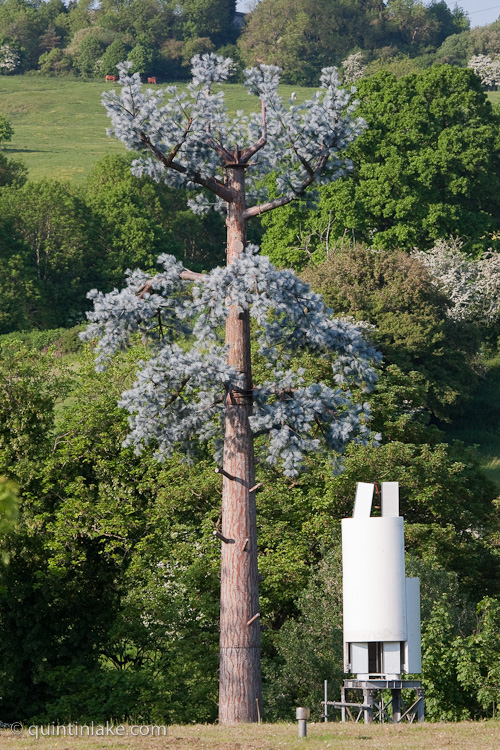
False Tree Mobile Phone Mast / Fake Cell phone Antenna Tower in English landscape.

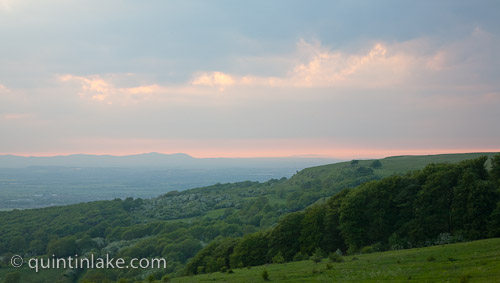
Cleeve common hill at dusk near Cheltenham, Malvern Hills in the distance, Gloucestershire, England

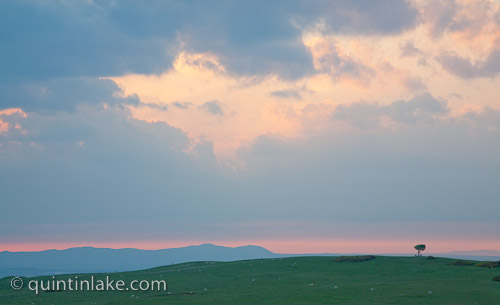
Solitary tree at Cleeve common hill at dusk near Cheltenham, Malvern Hills in the distance, Gloucestershire, England

BUY / LICENCE   MORE IMAGES of the Cotswold Way here

< Back to Day 7: Crickley Hill to Seven Springs

On to Day 9: Cleeve Hill to Stanway >

Photography © Quintin Lake, 2010

Overheating car, Long Barrow, Devils chimney, Cheltenham lookout, Disused quarry, Layers of limestone, Nettled path, Cerb grass, Family bikers, Roundabout graphics, Car-park smokers

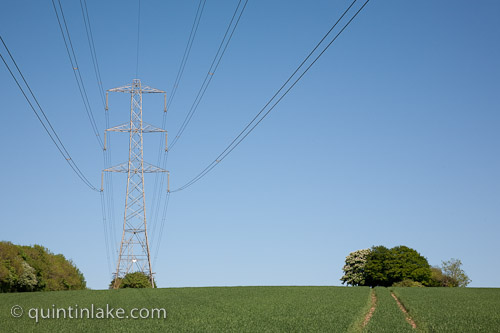
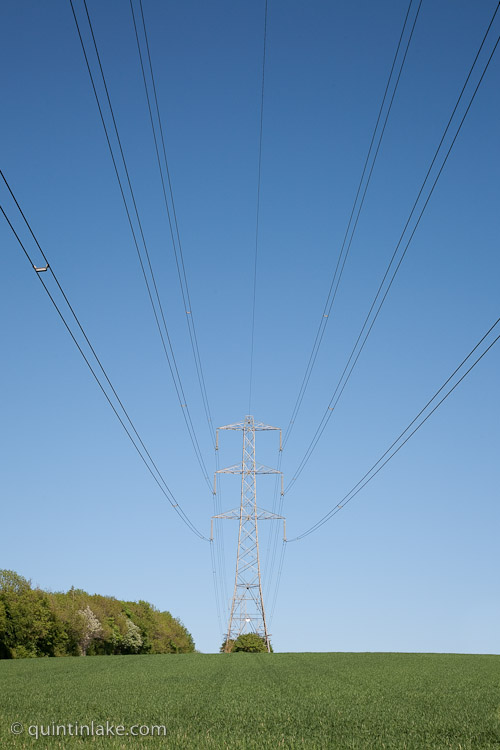
Electricity Pylon, suspension tower design set against a blue sky above a wheat field in early growth stage near Leckhampton Hill in Gloucestershire, England. The moon is visible above the copse.

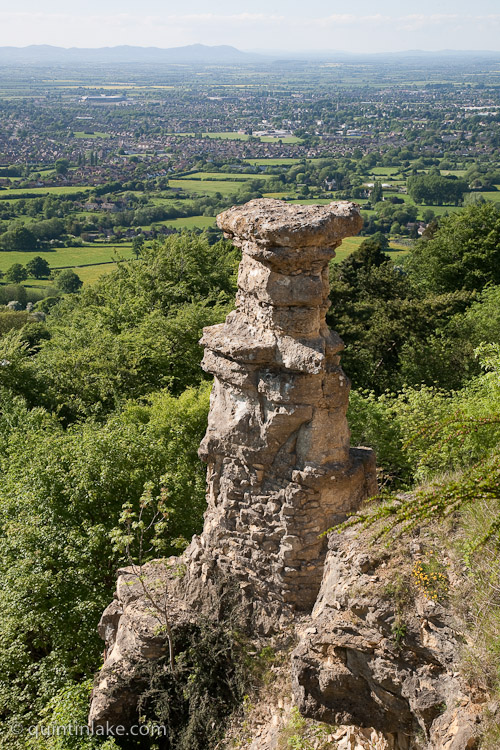
Devil's chimney made from Lower Freestone above a disused quarry in Leckhampton on the outskirts of Cheltenham

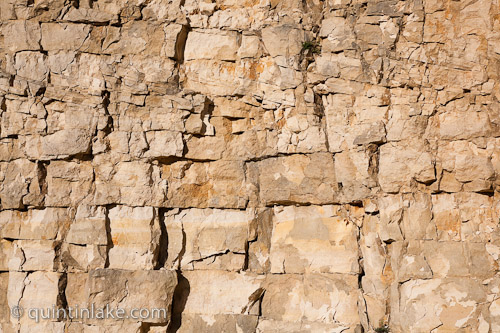
Detail of rock strata at old limestone quarry workings at Leckhampton Hill, Cheltenham, Gloucestershire

A couple admire the view over Cheltenham Spa town at the top of cliffs at Leckhampton Hill, Gloucestershire

Panoramic view of Cheltenham Spa Town from Wistley Hill

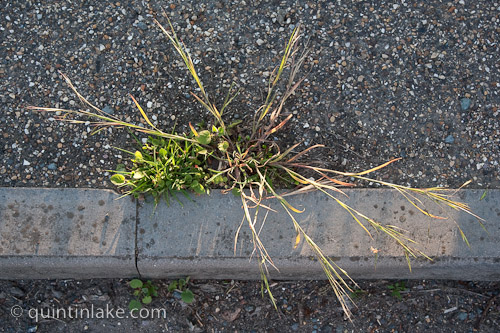
Grass explodes into life next to the curb stone of the A435 by the road at Seven Springs, Gloucestershire

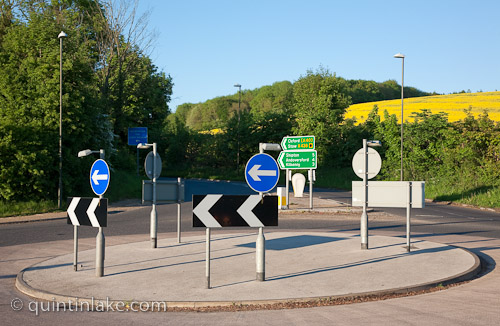
The A40 , A436 roundabout at Seven Springs, Gloucestershire

BUY / LICENCE   MORE IMAGES of the Cotswold Way here

< Back to Day 6: Cooper’s Hill to Crickley Hill

On to Day 8: Seven Springs to Cleeve Hill >

Photography © Quintin Lake, 2010

Elegant structures contrasting with the landscape, drawing a line across the landscape, through space and across the sky. Our modern world’s lifeblood elevated above the fields below. Confidently honest in form and function so unlike this deceit in steel.

Electricity Pylon, suspension tower design set against a blue sky above a wheat field in early growth stage near Leckhampton Hill in Gloucestershire, England.

Overhead power lines cut diagonally across the Cotswold landscape of rolling hills and fields Ravensgate Hill in Gloucestershire, England.

Looking up at an Electricity Pylon, carrying overhead power line with suspension tower design set against a blue sky at Ravensgate Hill in Gloucestershire, England.

Overhead power lines diagonally cross the Cotswold landscape of rolling hills and fields Ravensgate Hill in Gloucestershire, England.

Electricity Pylon, suspension tower design set against a blue sky above a wheat field in early growth stage near Leckhampton Hill in Gloucestershire, England

VIEW / LICENCE MORE IMAGES of Pylons & Overhead Power Lines here

Photography © Quintin Lake, 2010

Antarctic Explorer Sculpture, Horse Chestnut, Wild Garlic, Coloured arrows, Sun cream, Cheese rolling hill, Picnicking couple, Hidden reservoirs, Expensive pub, Indian family BBQ, Golden sunset, Rough track home

Bank of wild garlic in flower next to the Cotswold way forming a regular geometry of leaves. Cooper's Hill Wood

The Malvern hills seen from Witcombe wood on the Cotswold Way, England

Birdlip Hill, Cooper's Hill & Nut hill (L to R) seen from Barrow Wake on the Cotswold Escarpment on the Cotswold Way

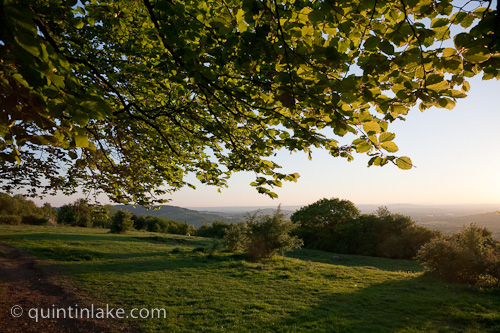
Cooper's Hill, Nut Hill & May Hill (L to R) seen from under a beech tree on Crickley Hill on the Cotswold Way

BUY / LICENCE   MORE IMAGES of the Cotswold Way here

< Back to Day 5: Leonard Stanley to Cooper’s Hill

On to Day 7: Crickley  Hill  to Seven Springs >

Photography © Quintin Lake, 2010

False Tree Mobile Phone Mast / Fake Cell phone Antenna Tower next to the A40 at Charlton Kings

This disguised Cell “tree” aka mobile phone mast is located next to the A40 at Charlton Kings, Cheltenham, Gloucestershire, England at the Offices of AlanDick which make these things worldwide.

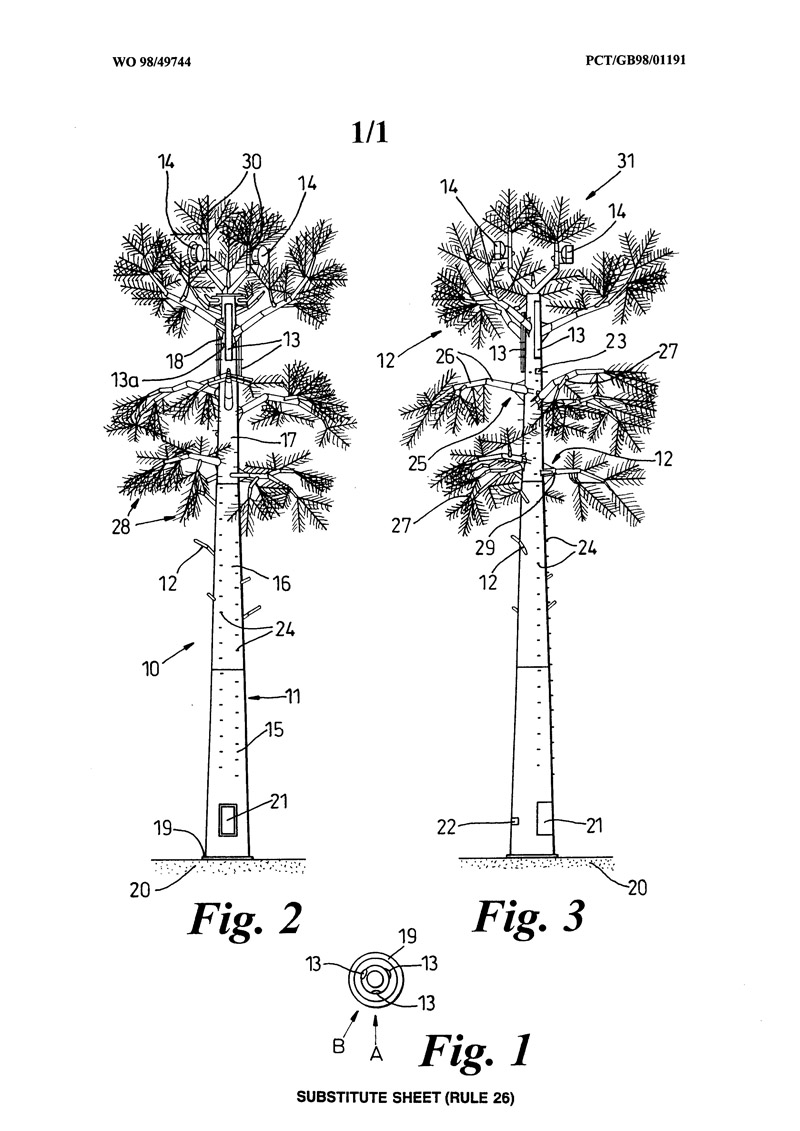
There are no actual transmitters attached to the “Trunk” in this example which makes it appear all the more surreal in contrast to the Cotswold landscape surrounding it. Having looked into it is seems to be the prototype for their patent for an “Antenna Tower in the form of a Tree

The details from the patent provide surprisingly entertaining reading:

“From a distance this arrangement provides an authentic looking tapering branch, without the necessity for complex forming of tubing.”

“The trunk may be formed by a metal tube, which preferably tapers, and the branches may extend through the trunk to be fixed to the other side either directly or via sockets.”

If you’d like to buy one for your back garden check out AlanDick Environmental Solutions

In the USA there is a “camouflaged” monopole, called a Monopalm maybe this one could be called “Obviouspruce”

VIEW / LICENCE MORE IMAGES of False Tree Mobile Phone Mast here

Figure from "Antenna Tower in the form of a Tree" patent

False Tree Mobile Phone Mast / Fake Cell phone Antenna Tower with additional white transmitter next to the A40 at Charlton Kings

VIEW / LICENCE MORE IMAGES of False Tree Mobile Phone Mast here

Photography © Quintin Lake, 2010

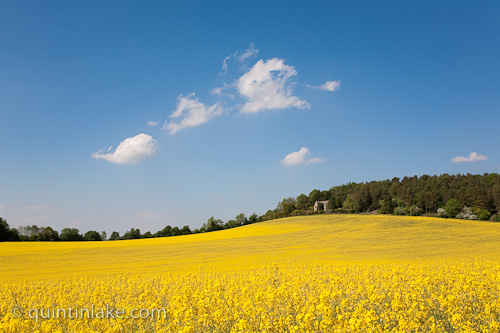
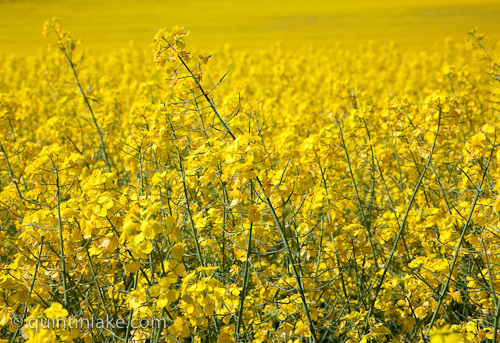
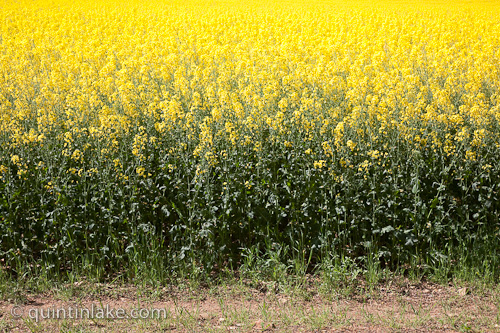
Photographs of a field of  bright yellow (canola) rapeseed in flower under a blue sky in Seven Springs, Gloucestershire, England. Rapeseed (Brassica napus), also known as rape, oilseed rape, rapa, rappi, rapaseed and (in the case of one particular group of cultivars, canola).

Rapeseed is grown for the production of animal feed, vegetable oil for human consumption, and biodiesel.

BBC Radio 4 Food Programme on rapeseed oil

BUY / LICENCE   MORE IMAGES of rapeseed oil fields here

Field of bright yellow rapeseed in flower (canola) under a blue sky overlooked by a solitary house in woodland. Seven Springs, Gloucestershire, England.

Bright yellow field of rapeseed in flower (canola) Close up of flowerhead. Seven Springs, Gloucestershire, England.

Edge of a field of yellow rapeseed in flower (canola) showing stems and flowerhead on a sunny day. Seven Springs, Gloucestershire, England.

Looking up at the edge of field of yellow rapeseed in flower (canola) showing stems and flowerhead under a blue sky on a sunny day. Seven Springs, Gloucestershire, England.

Ground eye view looking up in field of yellow rapeseed in flower (canola) showing stems and flowerhead under a blue sky on a sunny day. Seven Springs, Gloucestershire, England.

BUY / LICENCE   MORE IMAGES of rapeseed oil fields here

Photography © Quintin Lake, 2010

Quintin Lake “Drawing Parallels: Architecture Observed” Papadakis, 2009
ISBN 978-1906506-04-9 (Hardcover, 208 pages. £25. Colour throughout)

Reviewed by William Arthurs, Editor, London Society Journal

This fascinating book collects about 200 photographs of natural features, buildings and architectural detail from many countries around the world. Each page spread presents two photographs, with brief commentary, for the reader to compare and contrast. It is reviewed here because fifteen of the images are drawn from the London area and it is on some of these that I comment below, along with their comparisons.

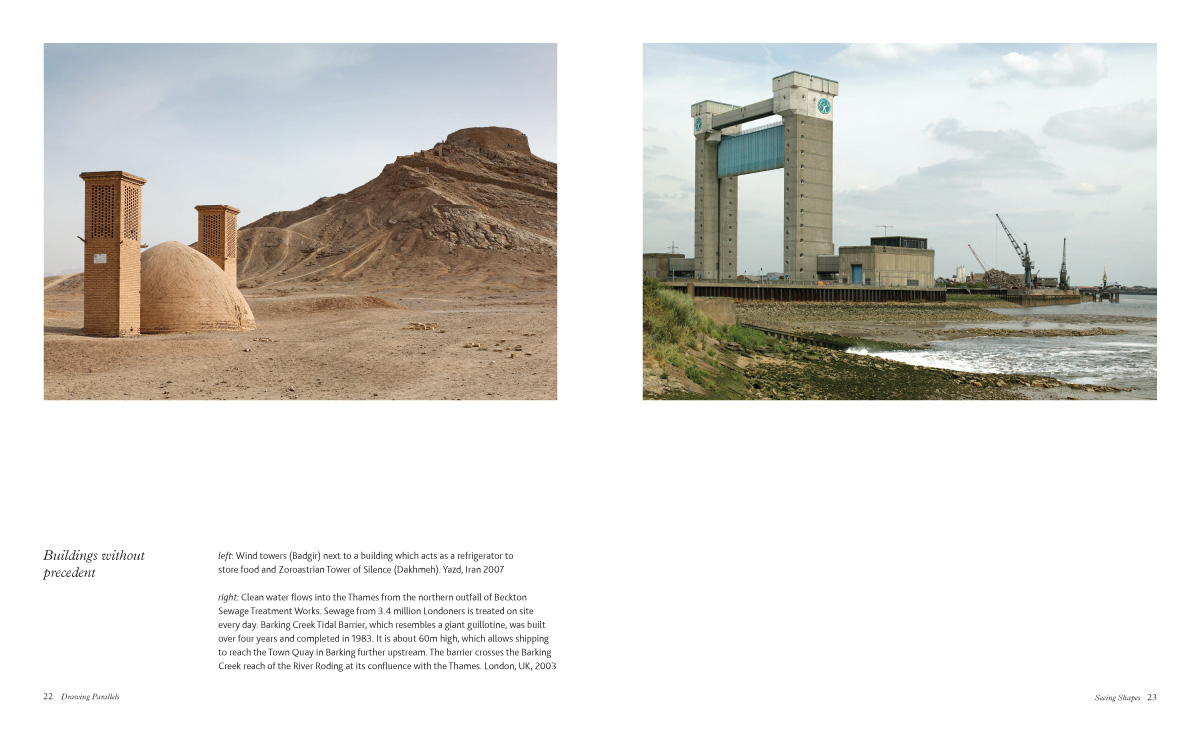
On pp. 22-3, a bleak Thames estuary landscape comprising the Barking Creek tidal barrier, resembling a giant guillotine, and the outfall of the Beckton Sewage Treatment works, is compared with a drier and more mysterious landscape in Yazd, Iran, with two square brick wind-towers, a conical brick building used as a refrigerator, and in the background a Zoroastrian Tower of Silence. I noted here the hidden nature of disposal – in the case of the Tower of Silence, the laying out of the corpses of the deceased on top of the tower is ritualistic, while the sewage works operate a mechanised and secular process of disposal (though one could compare some Victorian views of the sewer system, outlined by Dobraszczyk in “Into the Belly of the Beast”, also reviewed in this issue, and for which Quintin Lake provided the dustjacket image).
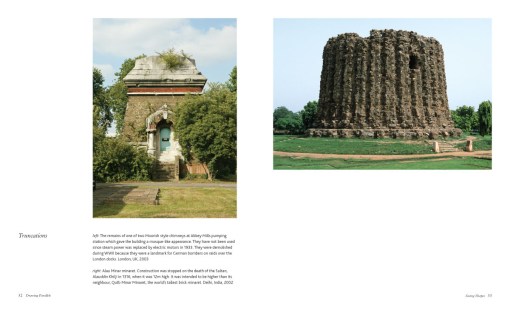
Next, on pp. 32-3, a comparison between the stump of one of the demolished Moorish-style chimneys at Abbey Mills pumping station (1865-8; these chimneys became redundant in the 1930s and were demolished during the Second World War) and the stump of the 14 th century Alau Minar brick minaret in Delhi, never completed. (Incidentally the Abbey Mills station as originally built is depicted on p. 114 of “Into the Belly of the Beast” and the chimneys are described on pp. 139 ff.). The Abbey Mills chimneys were 209 feet tall. The Delhi minaret was a more ambitious project as it was originally intended to be taller than its extant neighbour, Qutb Minar, at 240 feet the world’s tallest brick minaret.
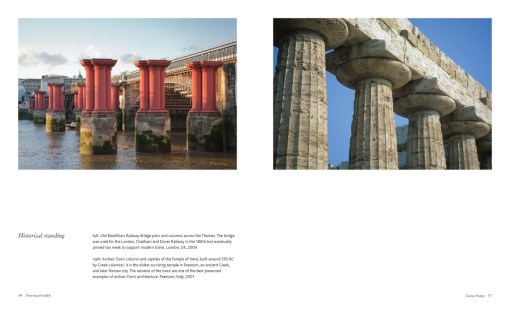
On pp. 36-7, a view familiar to our readers from the cover of issue 457 – the columns of the old Blackfriars Railway Bridge – are compared with some Doric columns at the Temple of Hera at Paestum (550 BC). In both cases, columns are left supporting not much, but still standing – but compare the materials and finish, and how they have weathered.
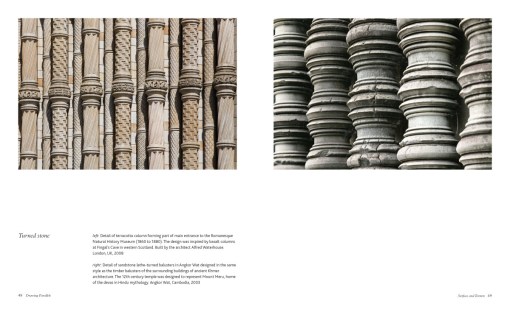
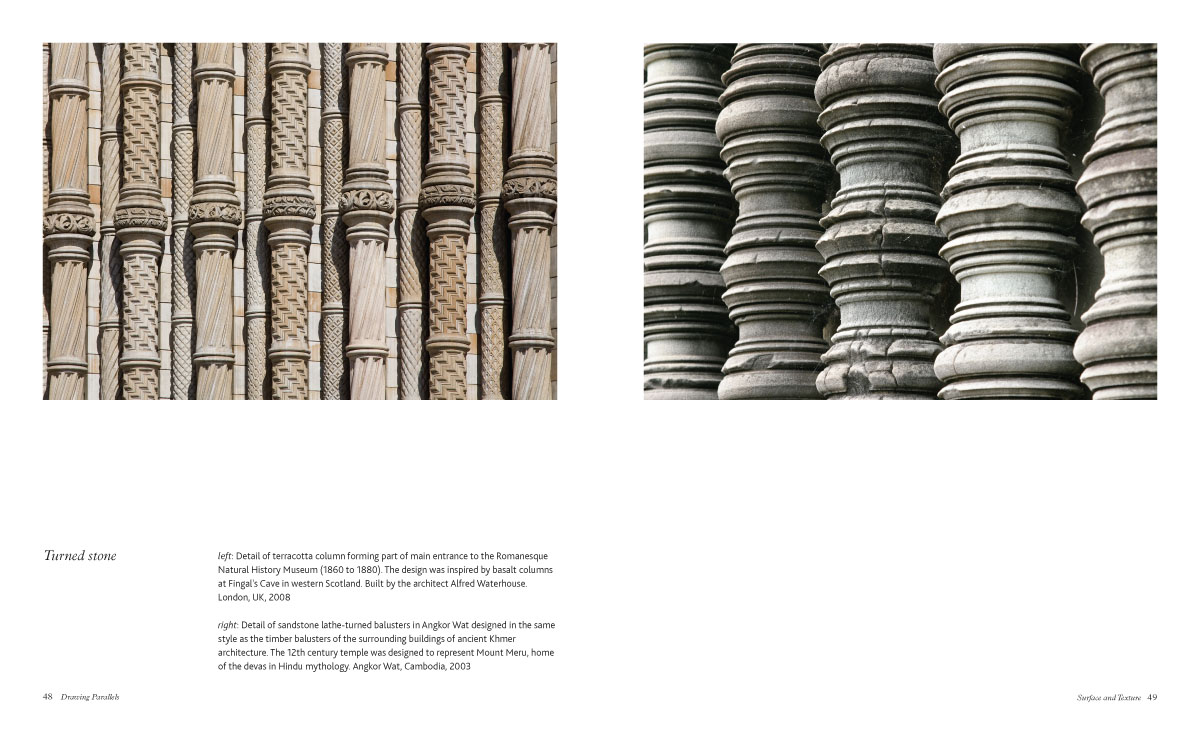
On pp. 48-9 a detail of the terracotta columns around the main entrance to the Natural History Museum (Alfred Waterhouse, 1860-1880) are compared with 12th century lathe-turned sandstone temple balusters at Angkor Wat. Here we are invited to compare texture, colour, to imagine the different processes for firing terracotta and turning sandstone, and to consider the
function of the buildings – a temple of science, and a Hindu temple.

Later photographs include the Gherkin, the Tower of London, Rachel Whiteread’s “House”, and vernacular settings in Walthamstow and in South London. A thought-provoking and beautifully-photographed collection to which I have found myself returning on many occasions.

William Arthurs, Editor, London Society Journal
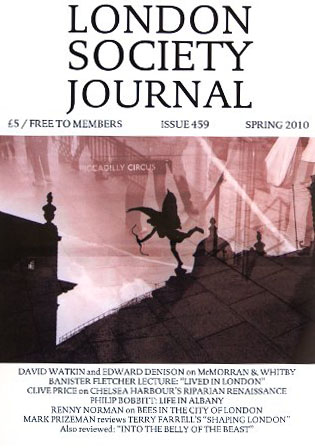
The London Society Journal is the magazine for members of the London Society and is published twice a year. The London Society was founded in 1912 and works to stimulate appreciation of London, to encourage excellence in planning and development, and to preserve its amenities and the best of its buildings.

Buy Drawing Parallels from Amazon UK here