Archives For author

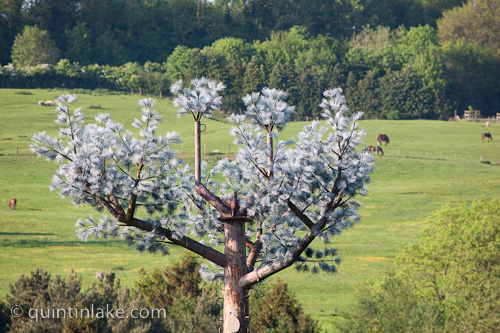
False Tree Mobile Phone Mast / Fake Cell phone Antenna Tower next to the A40 at Charlton Kings

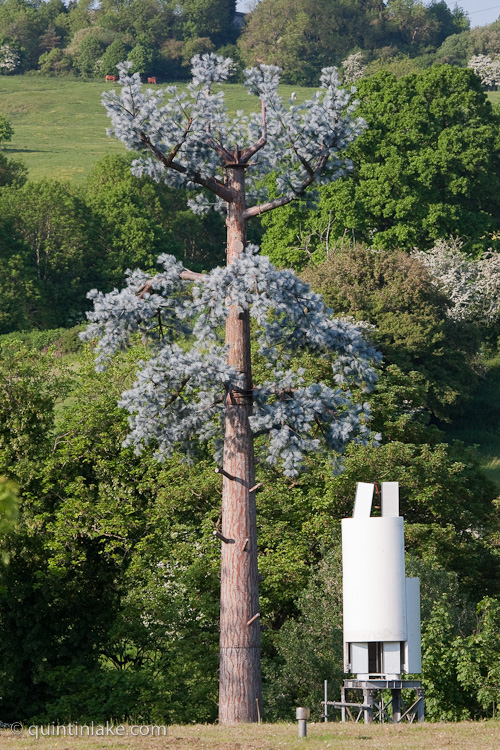
This disguised Cell “tree” aka mobile phone mast is located next to the A40 at Charlton Kings, Cheltenham, Gloucestershire, England at the Offices of AlanDick which make these things worldwide.

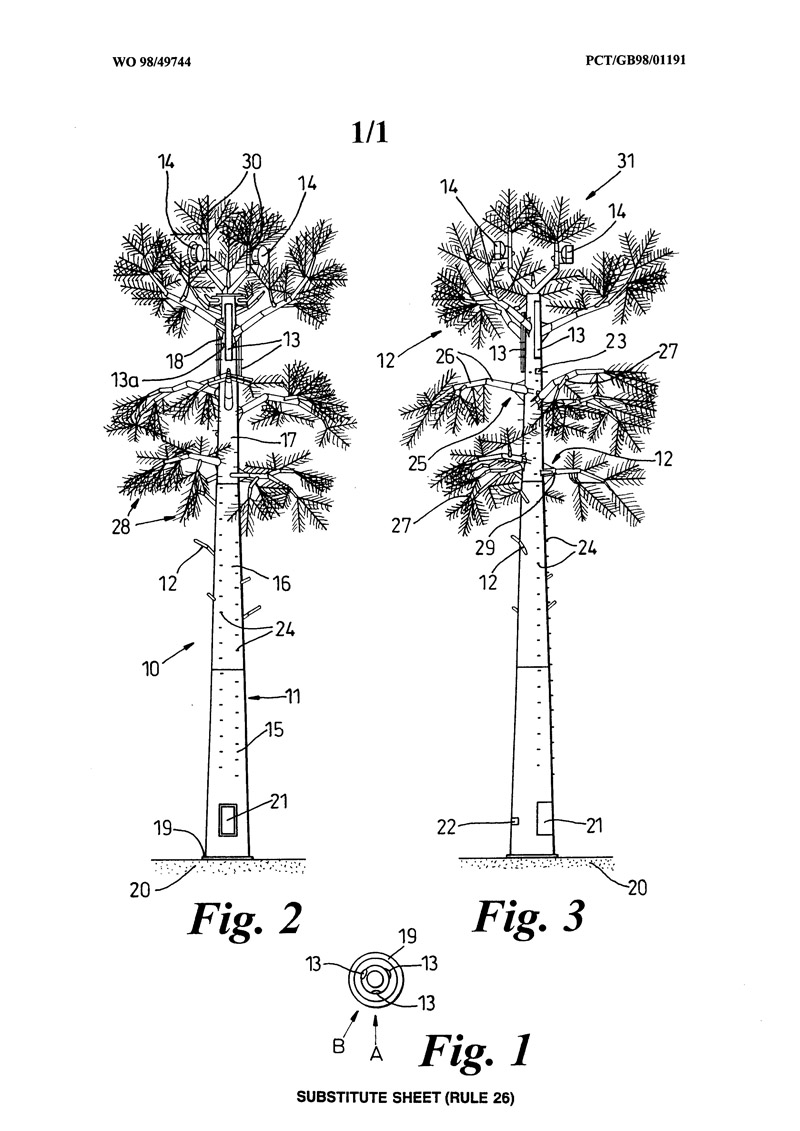
There are no actual transmitters attached to the “Trunk” in this example which makes it appear all the more surreal in contrast to the Cotswold landscape surrounding it. Having looked into it is seems to be the prototype for their patent for an “Antenna Tower in the form of a Tree

The details from the patent provide surprisingly entertaining reading:

“From a distance this arrangement provides an authentic looking tapering branch, without the necessity for complex forming of tubing.”

“The trunk may be formed by a metal tube, which preferably tapers, and the branches may extend through the trunk to be fixed to the other side either directly or via sockets.”

If you’d like to buy one for your back garden check out AlanDick Environmental Solutions

In the USA there is a “camouflaged” monopole, called a Monopalm maybe this one could be called “Obviouspruce”

VIEW / LICENCE MORE IMAGES of False Tree Mobile Phone Mast here

Figure from "Antenna Tower in the form of a Tree" patent

False Tree Mobile Phone Mast / Fake Cell phone Antenna Tower with additional white transmitter next to the A40 at Charlton Kings

VIEW / LICENCE MORE IMAGES of False Tree Mobile Phone Mast here

Photography © Quintin Lake, 2010

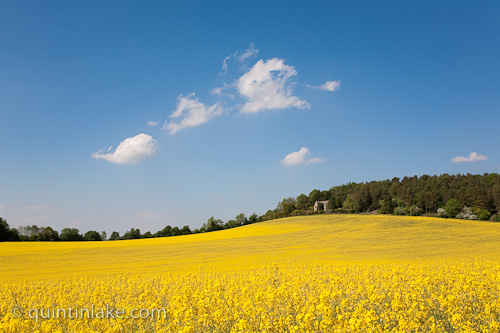
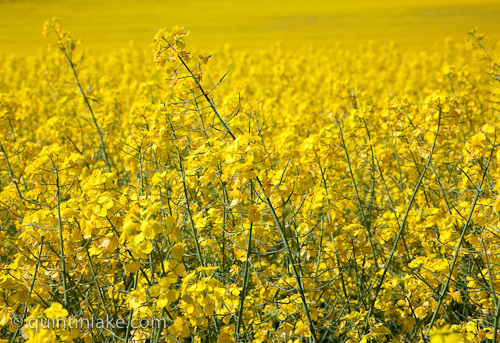
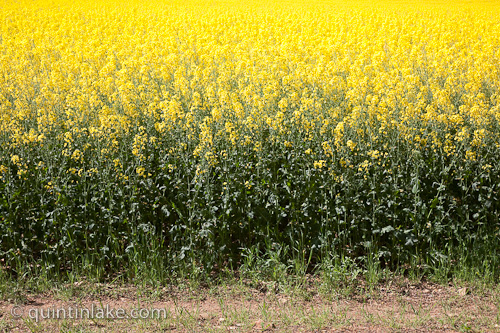
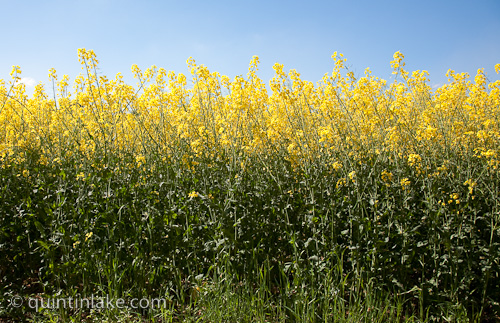
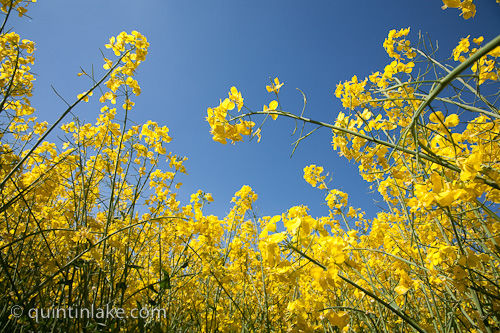
Photographs of a field of  bright yellow (canola) rapeseed in flower under a blue sky in Seven Springs, Gloucestershire, England. Rapeseed (Brassica napus), also known as rape, oilseed rape, rapa, rappi, rapaseed and (in the case of one particular group of cultivars, canola).

Rapeseed is grown for the production of animal feed, vegetable oil for human consumption, and biodiesel.

BBC Radio 4 Food Programme on rapeseed oil

BUY / LICENCE   MORE IMAGES of rapeseed oil fields here

Field of bright yellow rapeseed in flower (canola) under a blue sky overlooked by a solitary house in woodland. Seven Springs, Gloucestershire, England.

Bright yellow field of rapeseed in flower (canola) Close up of flowerhead. Seven Springs, Gloucestershire, England.

Edge of a field of yellow rapeseed in flower (canola) showing stems and flowerhead on a sunny day. Seven Springs, Gloucestershire, England.

Looking up at the edge of field of yellow rapeseed in flower (canola) showing stems and flowerhead under a blue sky on a sunny day. Seven Springs, Gloucestershire, England.

Ground eye view looking up in field of yellow rapeseed in flower (canola) showing stems and flowerhead under a blue sky on a sunny day. Seven Springs, Gloucestershire, England.

BUY / LICENCE   MORE IMAGES of rapeseed oil fields here

Photography © Quintin Lake, 2010

Holidays in Cubatão tells the story of an industrial landscape deep in the forests of Brazil through the eyes of an Australian who chooses this bizarre place to spend his holiday for no apparent reason.
The film was made in the fashion of the former Pascal Schöning’s Diploma Unit 3 and it has in its cast and crew five AA graduates: Chris Dukes, Quintin Lake, Julian Löffler, Isabel Pietri and Rubens Azevedo. More Info

Informa Cubatão News Article (In Portuguese)

A full gallery of documentary photographs can be seen here and making of photographs from the film here

Photography © Quintin Lake

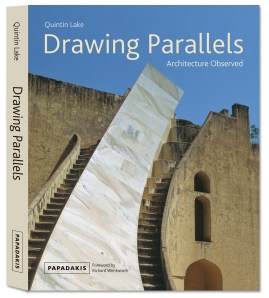
Quintin Lake “Drawing Parallels: Architecture Observed” Papadakis, 2009
ISBN 978-1906506-04-9 (Hardcover, 208 pages. £25. Colour throughout)

Reviewed by William Arthurs, Editor, London Society Journal

This fascinating book collects about 200 photographs of natural features, buildings and architectural detail from many countries around the world. Each page spread presents two photographs, with brief commentary, for the reader to compare and contrast. It is reviewed here because fifteen of the images are drawn from the London area and it is on some of these that I comment below, along with their comparisons.

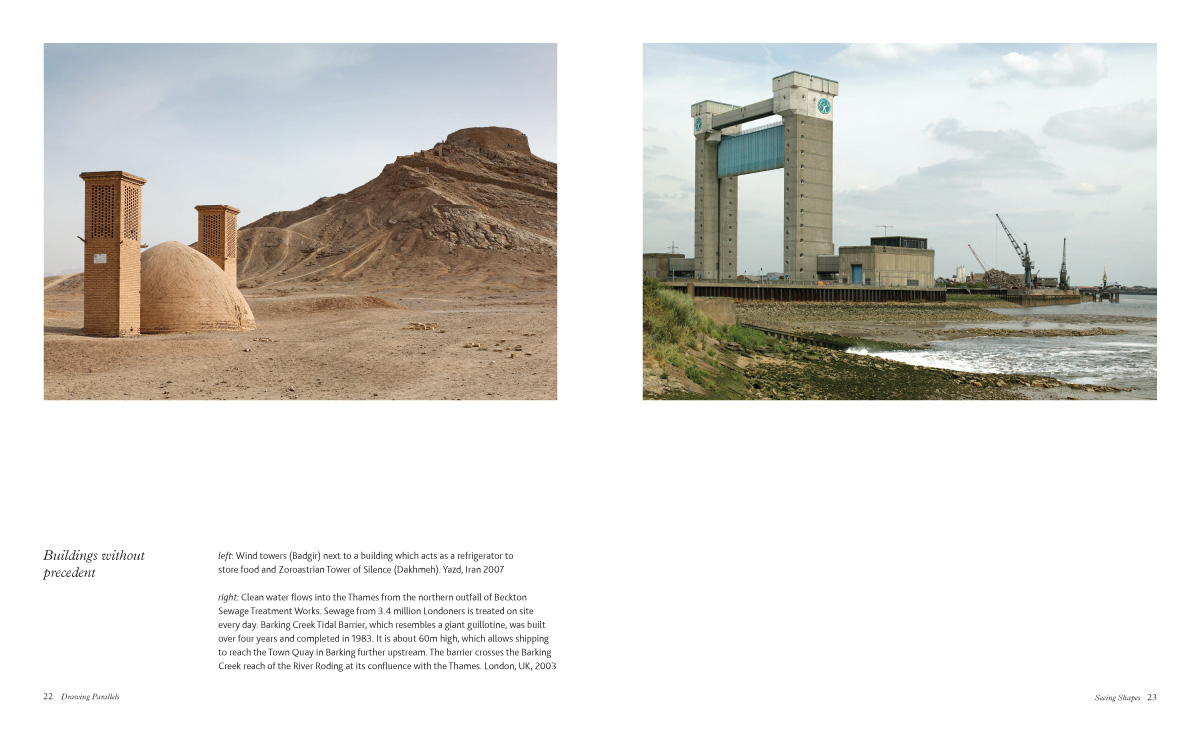
On pp. 22-3, a bleak Thames estuary landscape comprising the Barking Creek tidal barrier, resembling a giant guillotine, and the outfall of the Beckton Sewage Treatment works, is compared with a drier and more mysterious landscape in Yazd, Iran, with two square brick wind-towers, a conical brick building used as a refrigerator, and in the background a Zoroastrian Tower of Silence. I noted here the hidden nature of disposal – in the case of the Tower of Silence, the laying out of the corpses of the deceased on top of the tower is ritualistic, while the sewage works operate a mechanised and secular process of disposal (though one could compare some Victorian views of the sewer system, outlined by Dobraszczyk in “Into the Belly of the Beast”, also reviewed in this issue, and for which Quintin Lake provided the dustjacket image).
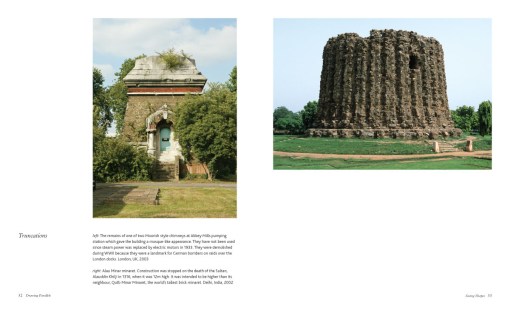
Next, on pp. 32-3, a comparison between the stump of one of the demolished Moorish-style chimneys at Abbey Mills pumping station (1865-8; these chimneys became redundant in the 1930s and were demolished during the Second World War) and the stump of the 14 th century Alau Minar brick minaret in Delhi, never completed. (Incidentally the Abbey Mills station as originally built is depicted on p. 114 of “Into the Belly of the Beast” and the chimneys are described on pp. 139 ff.). The Abbey Mills chimneys were 209 feet tall. The Delhi minaret was a more ambitious project as it was originally intended to be taller than its extant neighbour, Qutb Minar, at 240 feet the world’s tallest brick minaret.
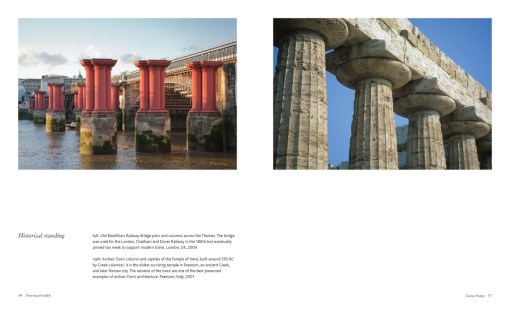
On pp. 36-7, a view familiar to our readers from the cover of issue 457 – the columns of the old Blackfriars Railway Bridge – are compared with some Doric columns at the Temple of Hera at Paestum (550 BC). In both cases, columns are left supporting not much, but still standing – but compare the materials and finish, and how they have weathered.
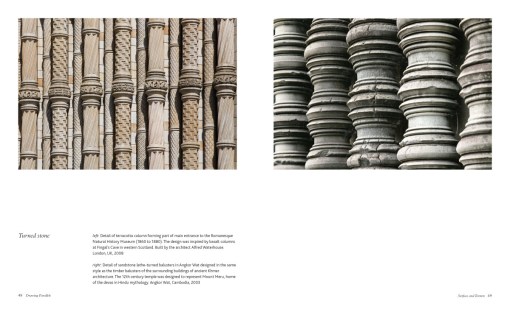
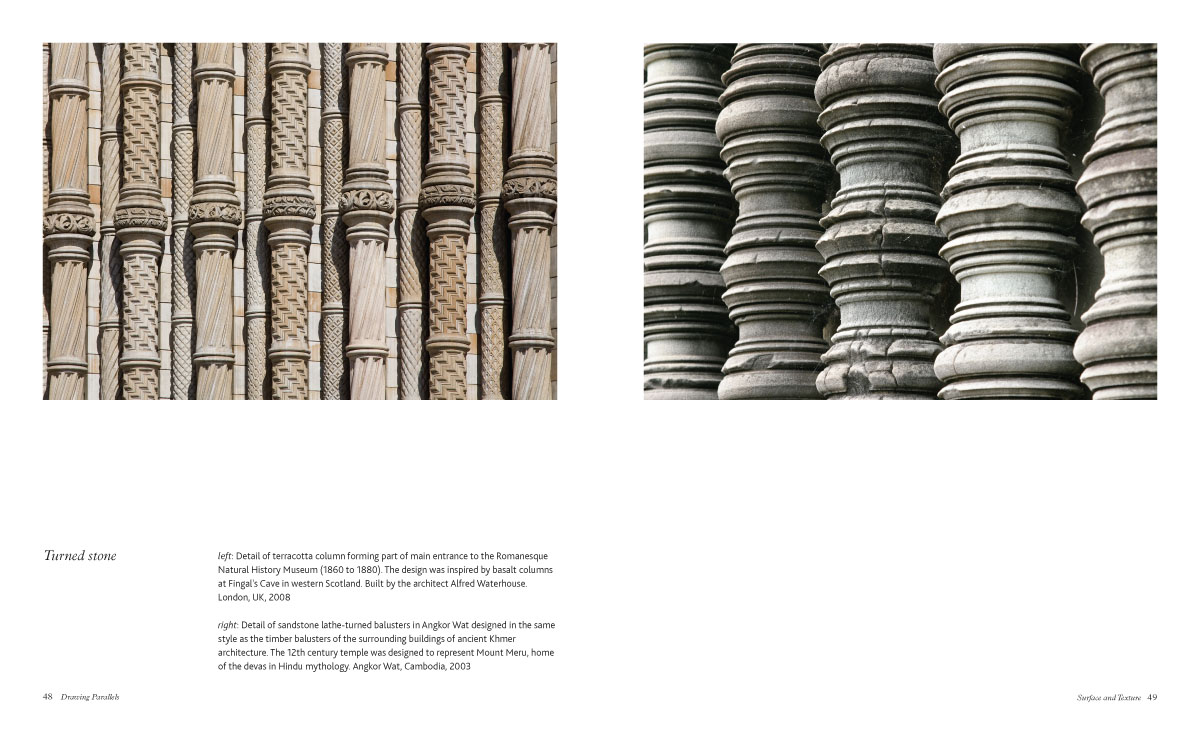
On pp. 48-9 a detail of the terracotta columns around the main entrance to the Natural History Museum (Alfred Waterhouse, 1860-1880) are compared with 12th century lathe-turned sandstone temple balusters at Angkor Wat. Here we are invited to compare texture, colour, to imagine the different processes for firing terracotta and turning sandstone, and to consider the
function of the buildings – a temple of science, and a Hindu temple.

Later photographs include the Gherkin, the Tower of London, Rachel Whiteread’s “House”, and vernacular settings in Walthamstow and in South London. A thought-provoking and beautifully-photographed collection to which I have found myself returning on many occasions.

William Arthurs, Editor, London Society Journal
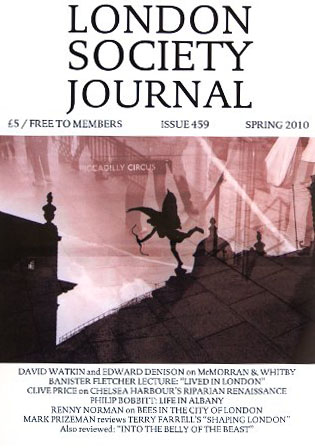
The London Society Journal is the magazine for members of the London Society and is published twice a year. The London Society was founded in 1912 and works to stimulate appreciation of London, to encourage excellence in planning and development, and to preserve its amenities and the best of its buildings.

Buy Drawing Parallels from Amazon UK here
Split tarmac, Oak leaves, Dandelion fields, Path as scar, Ancient settlement, Bed of bluebells, Cast topograph, World’s end, Purple orchids, Mill race, 99 yews, Women walking dogs, Iron age panorama, Faux stone house, Hairy caterpillar

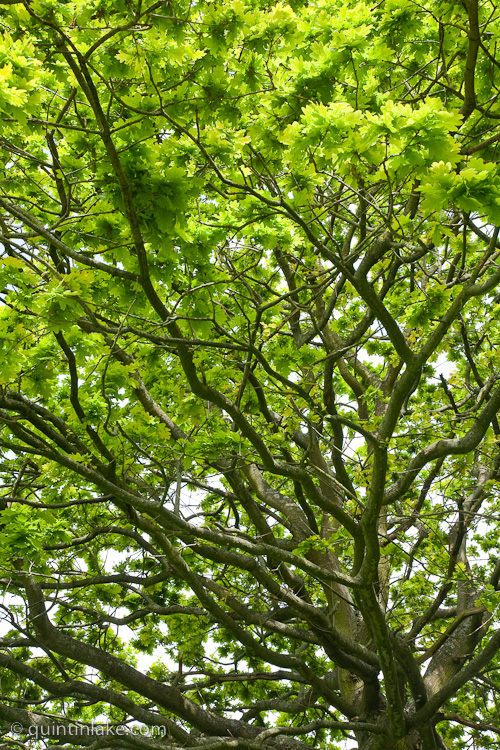
Light shines through leaves of an oak tree canopy in spring near Cotswold way. Gloucestershire, England

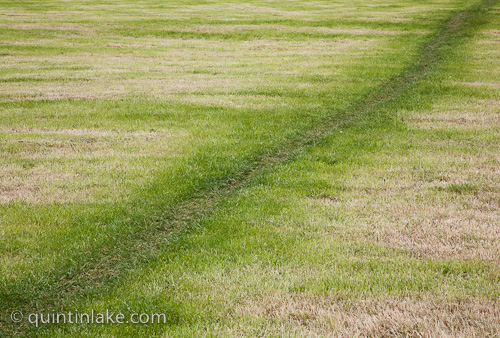
Path as scar. Maiden hill near Stroud. Cotswold way. Gloucestershire, England

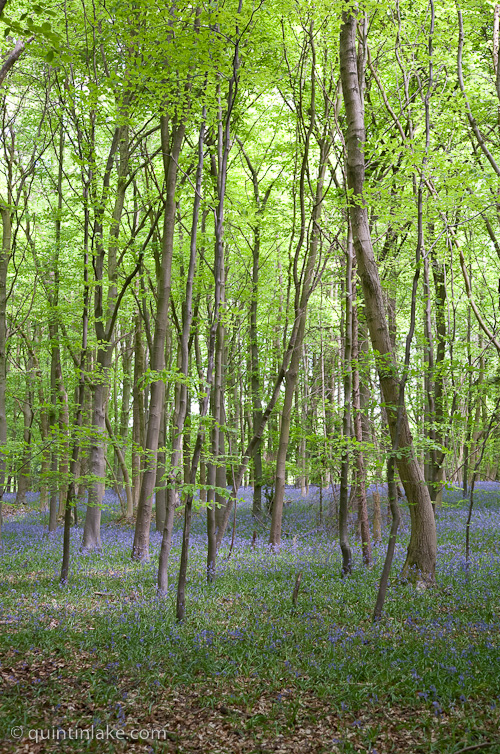
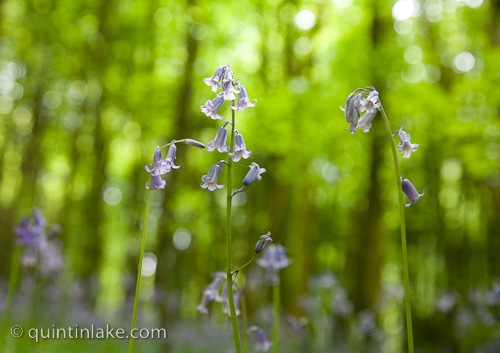
Sunlight falls on blanket of bluebells and beech trees at Standish Wood in spring near the Cotswold way. Gloucestershire, England

Bluebells in front of beech trees at Standish Wood in spring near the Cotswold way. Gloucestershire, England

Bluebells in front of beech trees at Standish Wood in spring near the Cotswold way. Gloucestershire, England

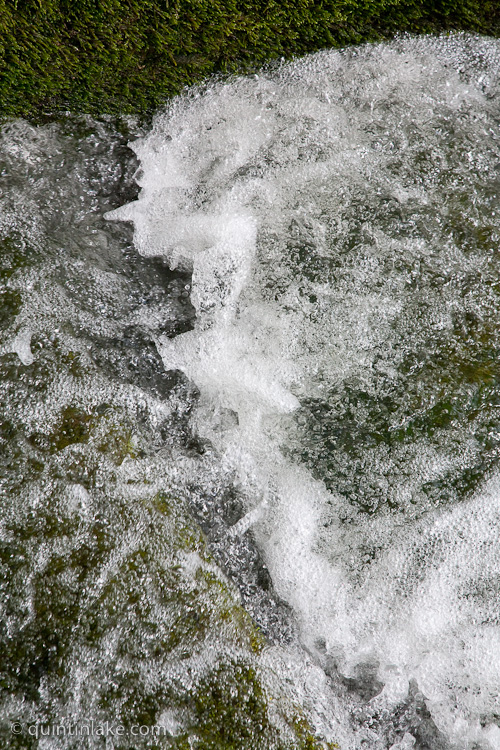
Bubbling water rushes by moss at the the mill race at Skinner's Mill, Painswick

Bubbling water rushes by moss at the the mill race at Skinner's Mill, Painswick

BUY / LICENCE   MORE IMAGES of the Cotswold Way here

< Back to Day 4: Dursley to Leonard Stanley

On to Day 6: Cooper’s Hill to Crickley Hill >

Photography © Quintin Lake, 2010

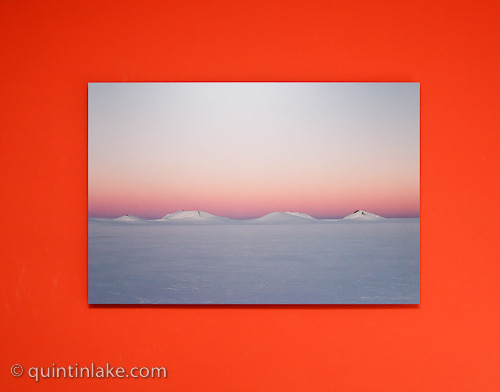
Selected images in my Archive are available as large format Lightjet Prints for display as wall art.

About the Aluminium Float Frame Lightjet Prints

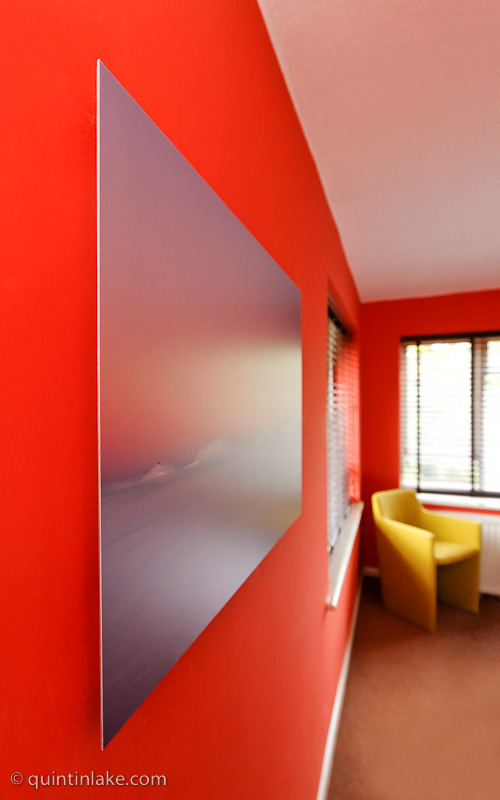
Lightjet are archival quality traditional photographic prints produced from digital source with laser light. The prints are laminated on a 4mm aluminium backing panel and aluminium sub-frame providing an absolutely flat surface. The frameless print appears to float 20mm off the surface of the wall. The 4mm edge of the aluminium panel is brushed raw aluminium. The print surface is sealed with a satin finish to protect from damage.

Available sizes

90x60cm lightjet print mounted on aluminium with aluminium sub-frame and seal

100x150cm lightjet print mounted on aluminium with aluminium sub-frame and seal

Sealed photograph laminated onto Aluminium gives a reflection-free absolutely flat image

90x60cm Print appears to float in front of wall, fitting in with modern decor. Angle of view also shows satin lamination.

Detail of corner of 100x150cm print showing print laminated to aluminum backing panel and aluminium sub-frame behind

Photography © Quintin Lake, 2010

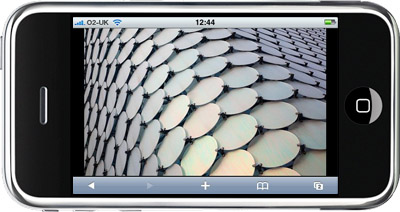
My Architectural & Documentary Photography Portfolio Website is now available to view on iphone & ipad supporting finger swipe, rotation and bookmarks (thanks livebooks!).

The new mobile version of the site site loads automatically if you browse to www.quintinlake.com via an iphone or ipad.

Quintin Lake Architectural Photography Portfolio now available to view on iphone & ipad.

Quintin Lake Architectural Photography Portfolio now available to view on iphone & ipad.

Photography © Quintin Lake, 2010

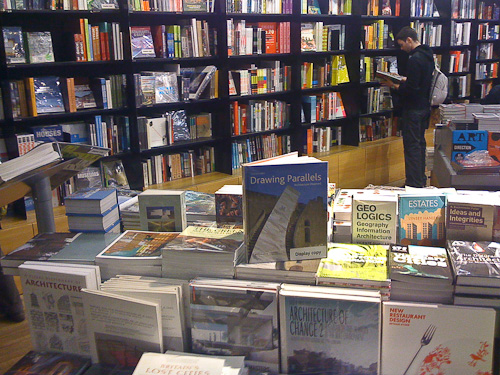
Drawing Parallels by Quintin Lake In the Architecture section of Tate Modern Bookshop, next to the turbine hall. Go grab a copy! or get it online here

Drawing Parallels by Quintin Lake in the Tate Modern Bookshop

Drawing Parallels by Quintin Lake in the Architecture section at Tate Modern Bookshop