Archives For author

“Architecture [is] a theatre stage setting where the leading actors are the people, and to dramatically direct the dialogue between these people and space is the technique of designing.”
Kisho Kurokawa

Public places and buildings have the added dimension of acting as arenas for our lives. In the virtual era we have a heightened awareness of the nature of illusion, of the fact that we are at one and the same time both observing and participating.We see buildings as the backdrop to history and human drama, no longer as organic wholes to which we are connected. In a global village we become tourists and visitors to the sets of a world of other cultures. The photographer, always the contriver and exposer of visual illusion, is attuned to this particularly contemporary phenomenon. Cities and places continually present new ironies, making the observer constantly aware of the layers of transparency. People become orchestrated crowds, and architecture a grand theatrical set, yet individuals are still glimpsed, asserting the defiantly human amongst the towering forests of forms.

Up to the neck

left: Fibreglass shark sculpture erected in 1986, on the 41st anniversary of the dropping of the first atomic bomb. Created by sculptor John Buckley for Bill Heine, who lives in the house. Neighbours tried to force Heine to remove the shark, but after an appeal to the UK’s Secretary of State for the Environment, it was allowed to remain. Oxford, England, 2009

right: Sculpted heads surrounding a front door in Lambeth. London, England, 2009

Click on image to enlarge or download Print Res (300dpi) PDF of this spread here

Spectating space
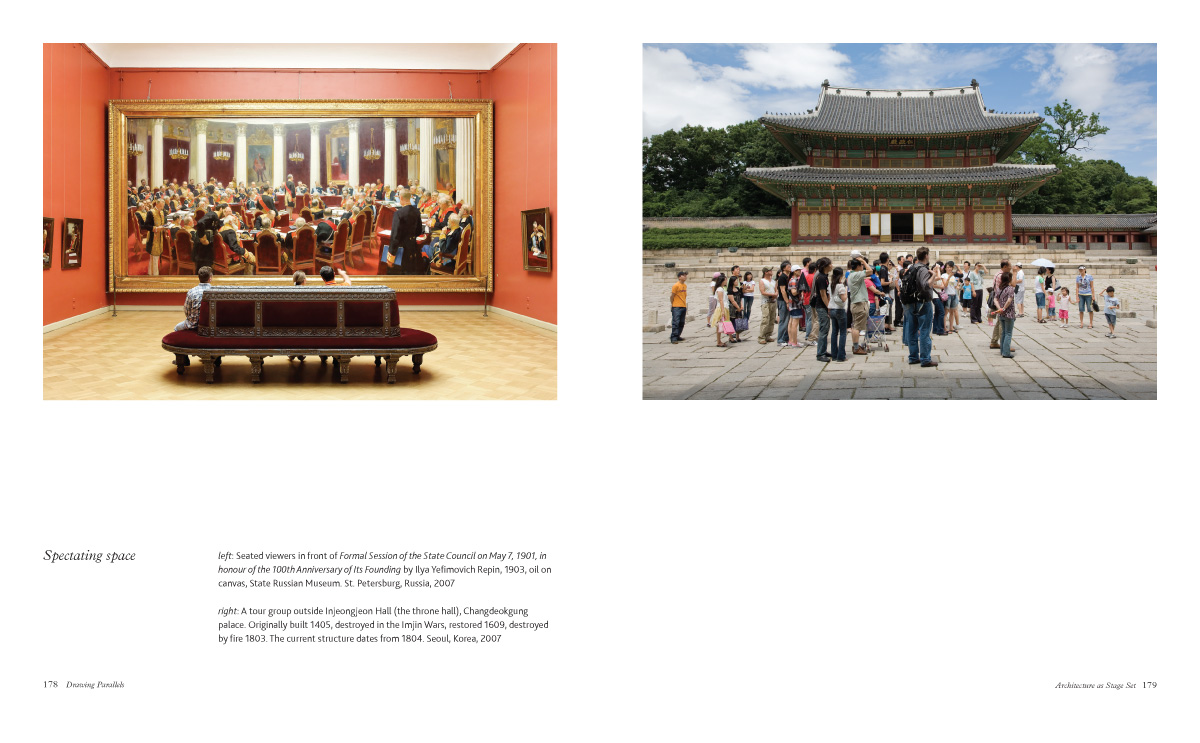
left: Seated viewers in front of Formal Session of the StateCouncil onMay 7, 1901, in honour of the 100th Anniversary of Its Founding by Ilya Yefimovich Repin, 1903, oil on canvas, State Russian Museum. St. Petersburg, Russia, 2007

right: A tour group outside Injeongjeon Hall (the throne hall), Changdeokgung palace. Originally built 1405, destroyed in the ImjinWars, restored 1609, destroyed by fire 1803. The current structure dates from 1804. Seoul, Korea, 2007

Click on image to enlarge or download Print Res (300dpi) PDF of this spread here
< Previous Chapter Extract

Next Chapter Extract>

“Memory is not an instrument for exploring the past but its theatre. It is the medium of past experience, as the ground is the medium in which dead cities lie interred.”
Walter Benjamin

A place is not a conglomeration of functional structures. Where we live, visit or observe, and the images we form and receive of it, gains its real nature from the feelings identified with it. An empty brutalist cityscape and an abandoned school gym, can speak of a more tragic dimension to our lives that is somehow inscribed in the very essence of a place. The way that vanished cultures persist in traces of their legacy, that nature reclaims vast human endeavours, that modern cruelty and power leave an aura or a sense of their very character in an ambience, is something that the photographer can capture. There are deeper, almost intangible remnants, some hauntingly sad, some joyful, that emerge as visual shocks or surprises, to be seen in the frozen image of a photograph. The chilling catastrophe of an abandoned city bereft of humanity clashes, paradoxically, with the defiant optimism of resurgent nature.

Reclamation

left: A doorway in Ta Prohm to a temple built in the late 12th and early 13th centuries as a monastery and university. The door is surrounded by silk cotton tree roots encased by strangler figs roots, which develop their own underground root
system. They then grow quickly, often strangling the host tree, which in time dies and rots away. The strangler fig continues to exist as a hollow tubular lattice that provides shelter for many forest animals. Siem Reap, Cambodia, 2003

right: A silver birch tree growing through the floor on the terrace of the Hotel Polissia 21 years after the Chernobyl disaster. Pripiat, Ukraine, 2007

Click on image to enlarge or download Print Res (300dpi) PDF of this spread here

Palimpsest

left: Lightswitch in a bedroom of the Hotel Polissia 21 years after the Chernobyl disaster. Pripiat, Ukraine, 2007

right: Billboard with posters removed at Green Park Underground Station. London, UK, 2009

Click on image to enlarge or download Print Res (300dpi) PDF of this spread here

< Previous Chapter Extract

Next Chapter Extract>

“All architecture is shelter, all great architecture is the design of space that contains, cuddles, exalts, or stimulates the persons in that space.”
Philip Johnson

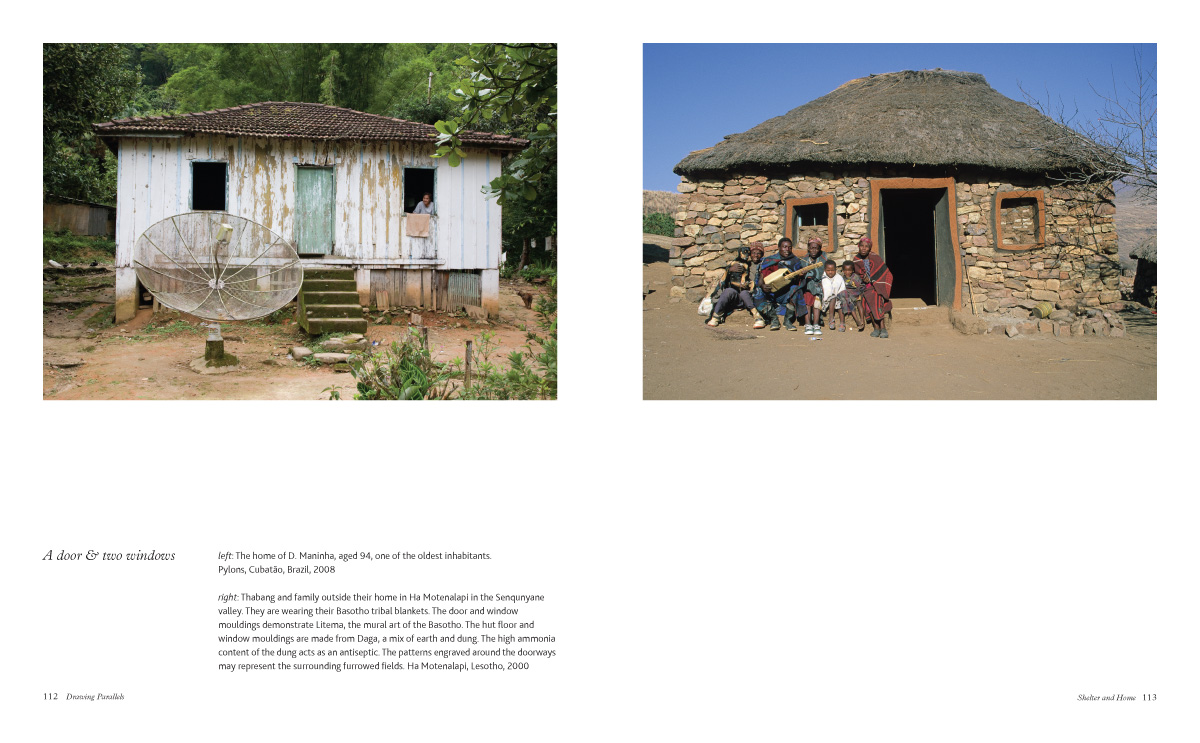
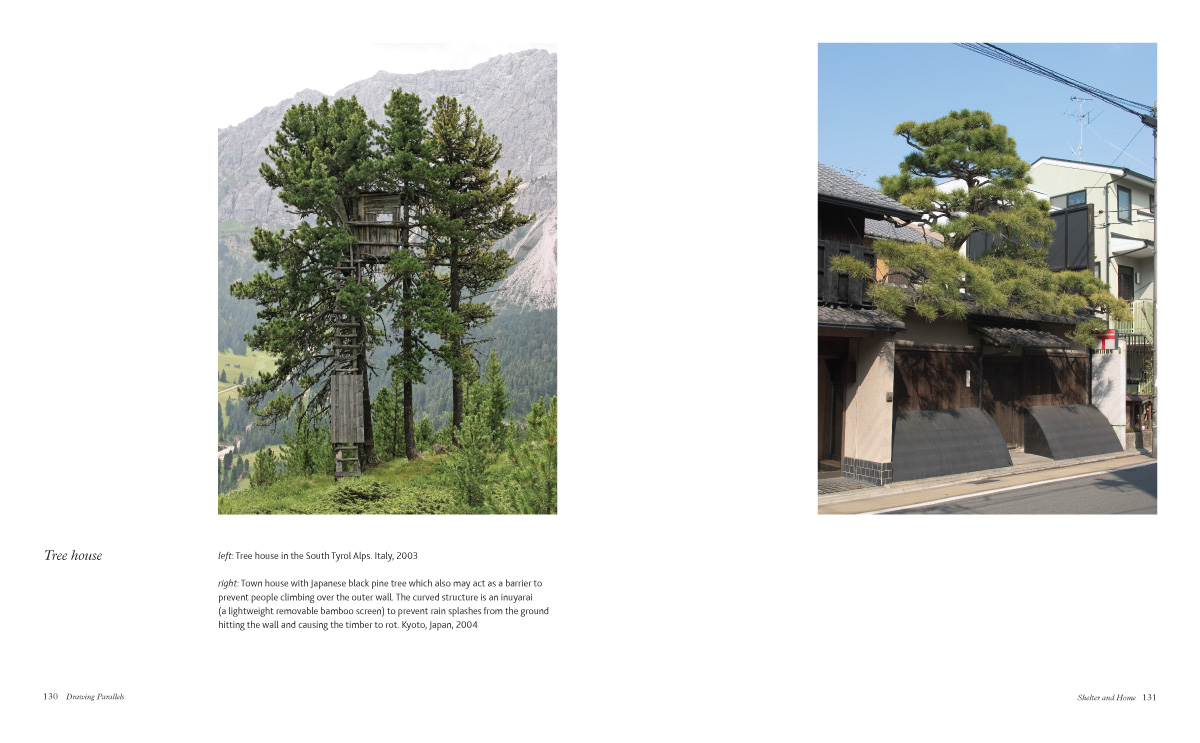
Photography captures both the visual appearance and the hidden intent inherent in a building. However transitory or ephemeral the structure, we can see the impetus for human survival in the act of creating a shelter, whatever the material, whether it is as ancient and fundamental as stone and wood, or as modern and widespread as glass, concrete and plastic. The fact that a dwelling embodies a more complex range of impulses, a strange mixture of domesticity and adornment, a basic expression of identity, in what can only be hinted at in the concept of home, forms the secret emotional dimension to architecture that emerges in the photograph. This is another landscape, beyond function and form, an emotional and psychological aspect that is only just beginning to be charted in these far-reaching visual connections.

A door & two windows

left: The home of D. Maninha, aged 94, one of the oldest inhabitants. Pylons, Cubatão, Brazil, 2008

right: Thabang and family outside their home in Ha Motenalapi in the Senqunyane valley. They are wearing their Basotho tribal blankets. The door and window mouldings demonstrate Litema, the mural art of the Basotho. The hut floor and window mouldings are made from Daga, a mix of earth and dung. The high ammonia content of the dung acts as an antiseptic. The patterns engraved around the doorways may represent the surrounding furrowed fields. Ha Motenalapi, Lesotho, 2000

Click on image to enlarge or download Print Res (300dpi) PDF of this spread here

Tree house

left: Tree house in the South Tyrol Alps. Italy, 2003

right: Town house with Japanese black pine tree which also may act as a barrier to prevent people climbing over the outer wall. The curved structure is an inuyarai (a lightweight removable bamboo screen) to prevent rain splashes from the ground hitting the wall and causing the timber to rot. Kyoto, Japan, 2004

Click on image to enlarge or download Print Res (300dpi) PDF of this spread here

< Previous Chapter Extract

Next Chapter Extract>

“Architecture is the will of an epoch translated into space.”
Mies van der Rohe

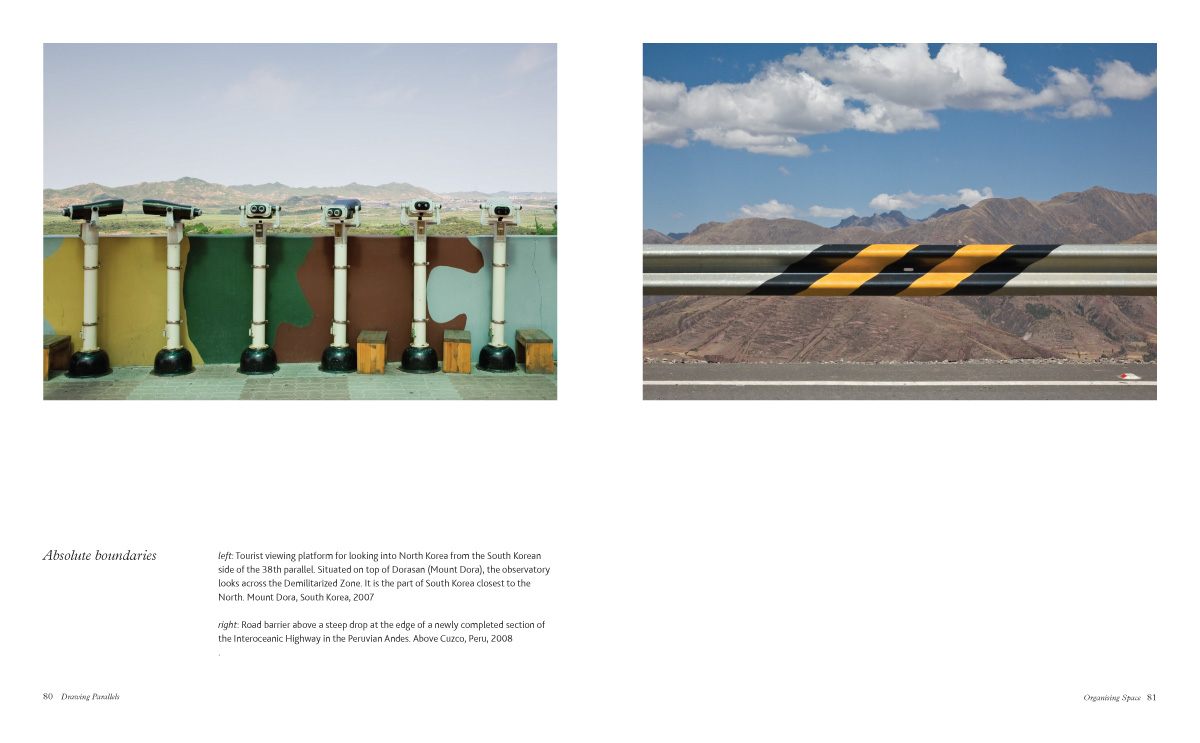
The organisation of space is the realm of both architect and photographer. The nature of space, and the very means by which we recognise it, is always fluid and transitory. The photographer not only recognises great established relationships between familiar structures and their environment, but also observes the constantly evolving realignments or mutations, which exist between tradition and modernity, as much as between manmade structures and nature. There are moments of random interaction between humanity and the great landscapes of the natural world where an almost instinctive relationship can be captured in something as simple as a workmen’s goal mouth by a highway. Barriers, enclosures, walls and routes are not just overt structures but unspoken strictures. These attempts at definition and containment speak of deeper cultural and political truths. By looking at them, by bringing them together, hidden realities and sinister webs of power are gradually revealed.

Absolute boundaries

left: Tourist viewing platformfor looking into North Korea from the South Korean side of the 38th parallel. Situated on top of Dorasan (Mount Dora), the observatory looks across the Demilitarized Zone. It is the part of South Korea closest to the North. Mount Dora, South Korea, 2007

right: Road barrier above a steep drop at the edge of a newly completed section of the Interoceanic Highway in the Peruvian Andes. Above Cuzco, Peru, 2008

Click on image to enlarge or download Print Res (300dpi) PDF of this spread here

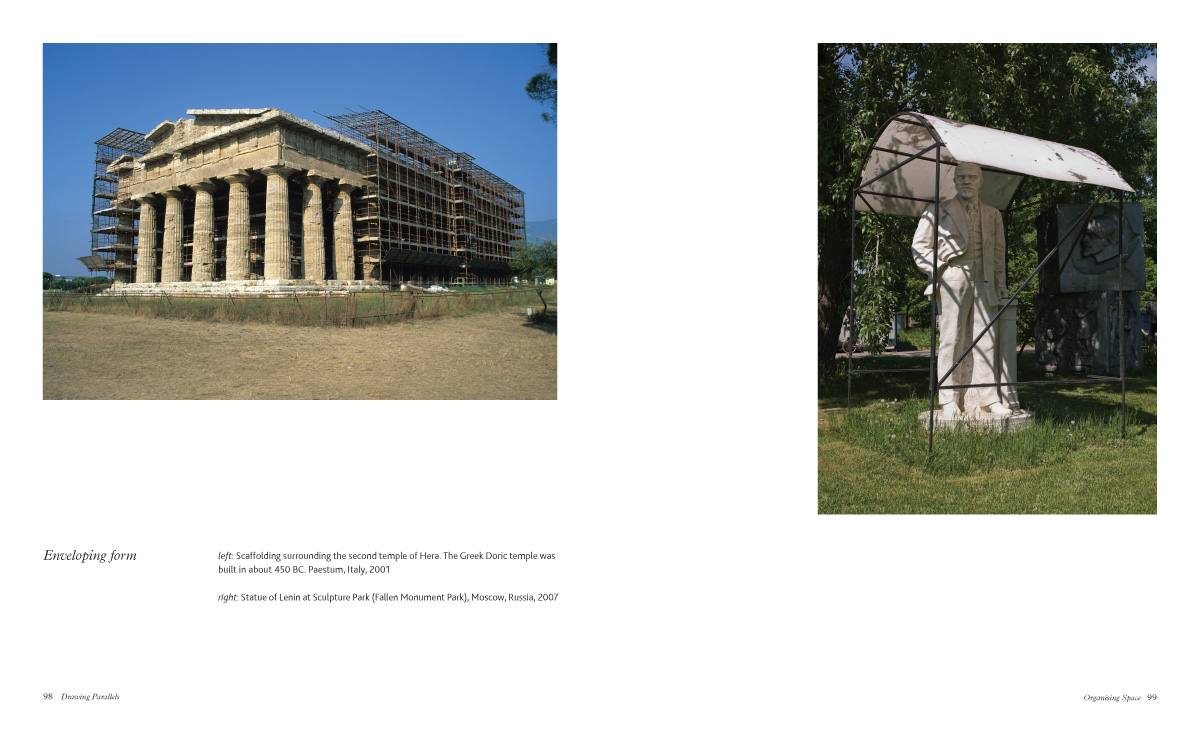
Enveloping form

left: Scaffolding surrounding the second temple of Hera. The Greek Doric temple was built in about 450 BC. Paestum, Italy, 2001

right: Statue of Lenin at Sculpture Park (Fallen Monument Park), Moscow, Russia, 2007

Click on image to enlarge or download Print Res (300dpi) PDF of this spread here

< Previous Chapter Extract

Next Chapter Extract>

“Sometimes I enjoy just photographing the surface because I think it can be as revealing as going to the heart of the matter.”
Annie Leibovitz

Architecture has a texture. Whilst it is a commonplace that the very materials of buildings, both ancient and modern, contribute to their character, looking again at, or observing, the very fabric and substance of this aspect of the art, brings to life almost another art form in itself. For the photographer these architectural building blocks, from the smoothest marble to the roughest stone felt underfoot, from intricately glazed tiles to roughly cut timber in an ancient temple, merge into images where an alternative aesthetic is seen, beyond the functional or the decorative. The photographer can also register the elusive interplay of light with materials. It is in the bringing together of these moments, whether it is the natural vernacular of an ancient or traditional landscape with the neon radiance of a modern Chinese office block, that provides truly novel commentary.

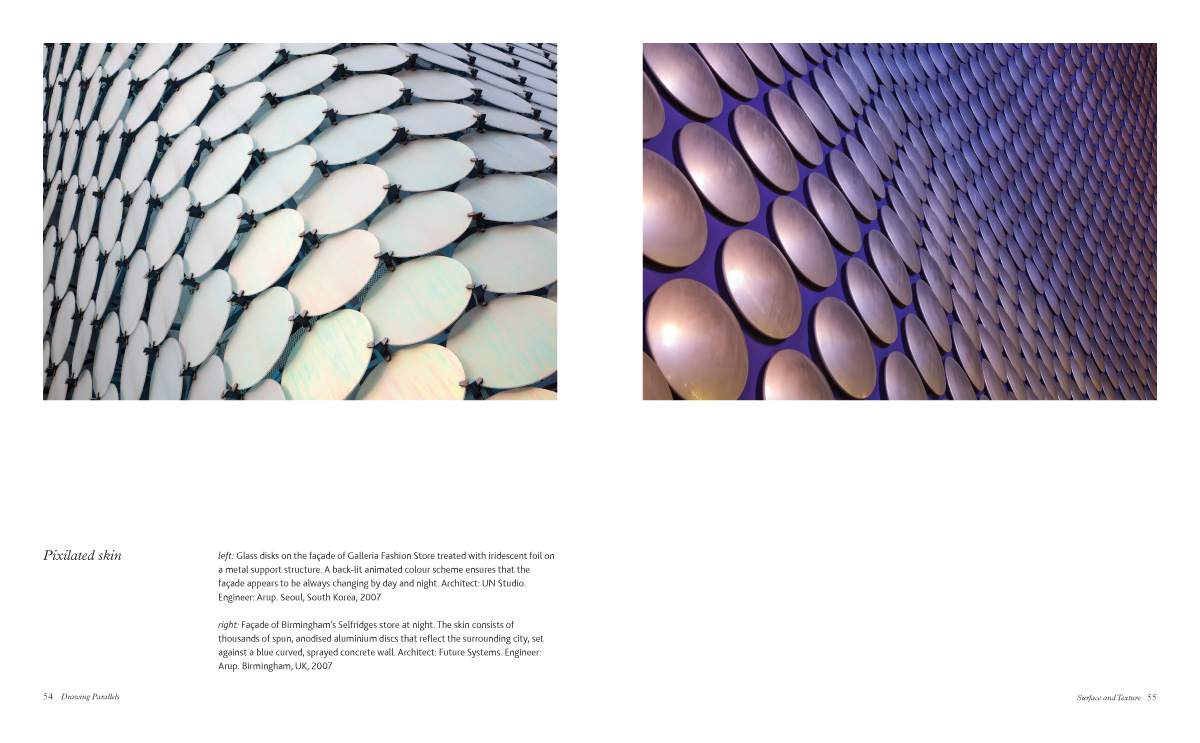
Pixilated skin

left: Glass disks on the façade of Galleria Fashion Store treated with iridescent foil on a metal support structure. A back-lit animated colour scheme ensures that the façade appears to be always changing by day and night. Architect: UN Studio. Engineer: Arup. Seoul, South Korea, 2007

right: Façade of Birmingham’s Selfridges store at night. The skin consists of thousands of spun, anodised aluminium discs that reflect the surrounding city, set against a blue curved, sprayed concrete wall. Architect: Future Systems. Engineer: Arup. Birmingham, UK, 2007

Click on image to enlarge or download Print Res (300dpi) PDF of this spread here

Responsive skin

left: Detail of aluminium sunscreens on the façade of the Esplanade, Theatres on the Bay, Singapore. The shields are set to be more open or closed depending on the angle at which the sun hits them, affording the glass façades protection from direct
sunlight without limiting the view. Many Singaporeans casually refer to the Esplanade as the Durian because of its resemblance to the tropical fruit. Architect: Michael Wilford & Partners & DP Architects Singapore. Singapore, 2003

right: Timber roof tiles of an alpine hay barn, South Tyrol, Italy, 2002

Click on image to enlarge or download Print Res (300dpi) PDF of this spread here

< Previous Chapter Extract

Next Chapter Extract>

“I often think of that rare fulfilling joy when you are in the presence of some wonderful alignment of events. Where the light, the colour, the shapes, and the balance all interlock so perfectly that I feel truly overwhelmed by the wonder of it.”
Charlie Waite

If architecture is the act of making shapes, from a detail to an overall impression, part of the art of photography is seeing and registering the wealth of changing forms and patterns that are created by the harmony and clash of buildings with their environments. The art of the contemporary photographer allows for the fine precision of focus on unnoticed, forgotten and ignored details which exist almost as structures in their own right. A doorway, a ceiling, a corner or a façade can come to life through the recognition of a composition. There are new forms, almost new works, created by the erosion of time. Decay and neglect fashion something fresh, whilst a fragment of a former whole achieves a revelatory beauty in its own right. This gallery of experience is new for each generation. The contemporary photographer not only notices and composes, but he can assemble to make unique modern statements.

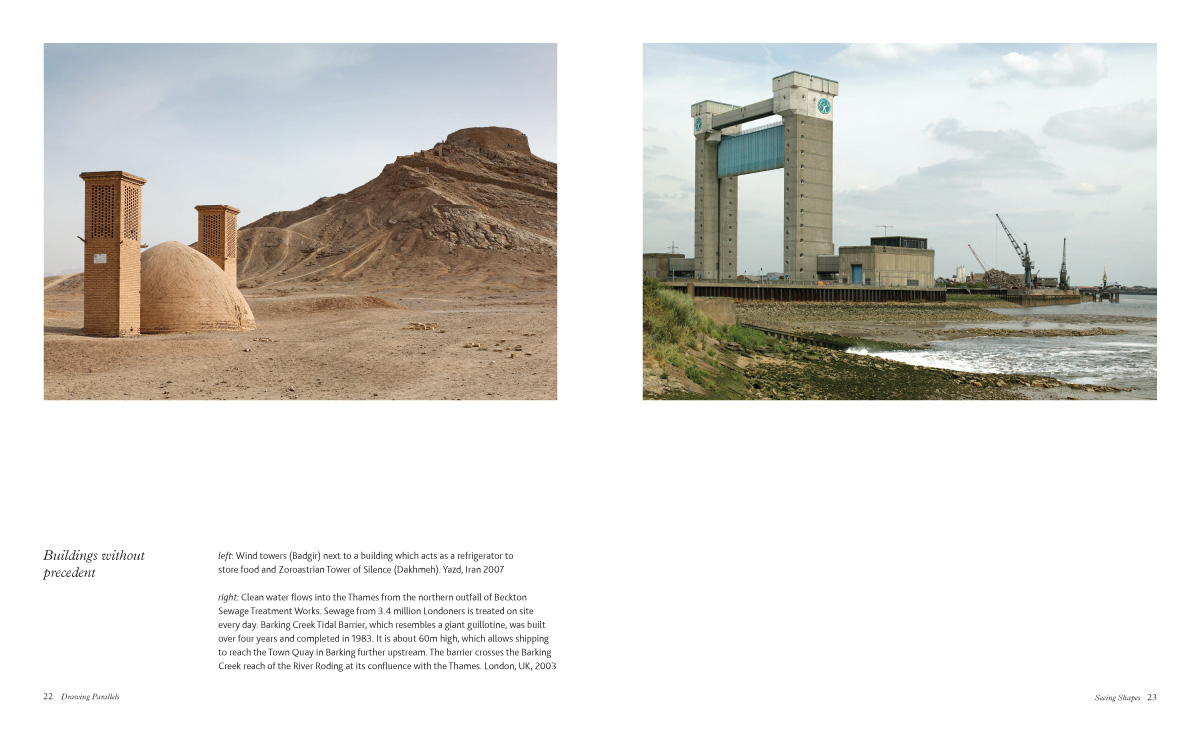
Buildings without precedent

left:Wind towers (Badgir) next to a building which acts as a refrigerator to store food and Zoroastrian Tower of Silence (Dakhmeh). Yazd, Iran 2007

right: Clean water flows into the Thames from the northern outfall of Beckton Sewage TreatmentWorks. Sewage from 3.4 million Londoners is treated on site every day. Barking Creek Tidal Barrier, which resembles a giant guillotine, was built over four years and completed in 1983. It is about 60m high, which allows shipping to reach the Town Quay in Barking further upstream. The barrier crosses the Barking Creek reach of the River Roding at its confluence with the Thames. London, UK, 2003

Click on image to enlarge or download Print Res (300dpi) PDF of this spread here

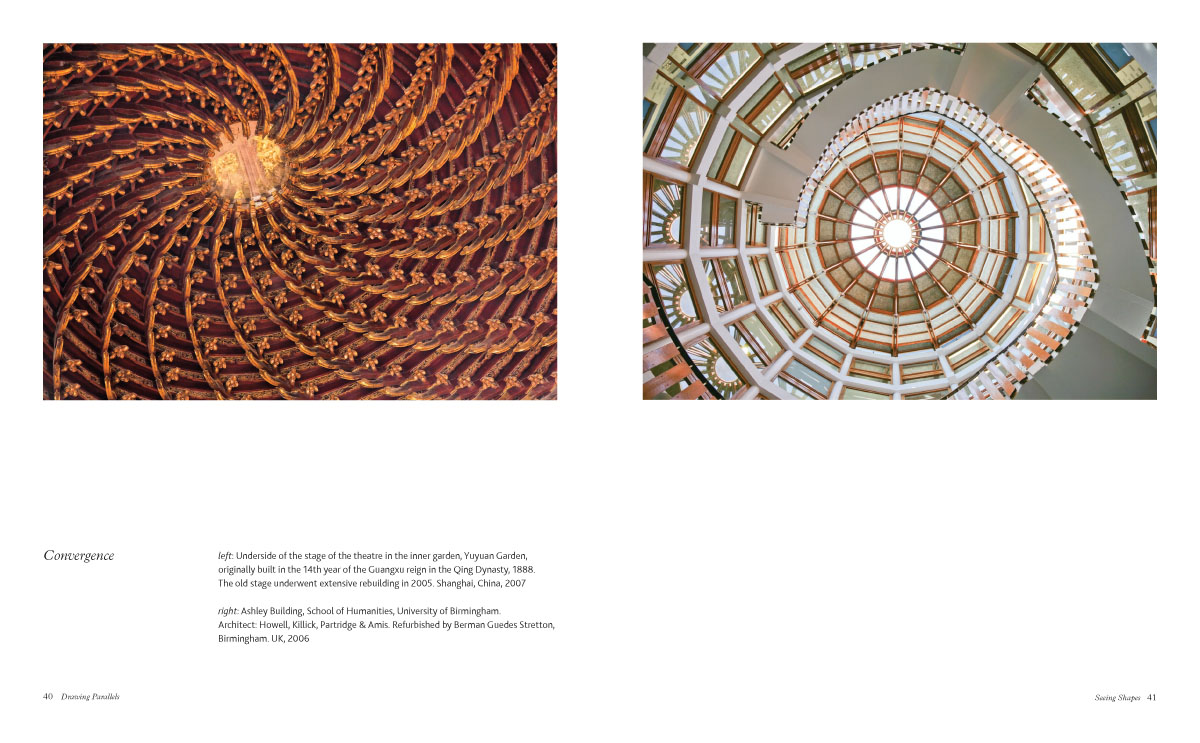
Convergence

left: Underside of the stage of the theatre in the inner garden, Yuyuan Garden, originally built in the 14th year of the Guangxu reign in the Qing Dynasty, 1888. The old stage underwent extensive rebuilding in 2005. Shanghai, China, 2007

right: Ashley Building, School of Humanities, University of Birmingham. Architect: Howell, Killick, Partridge & Amis. Refurbished by Berman Guedes Stretton, Birmingham. UK, 2006

Click on image to enlarge or download Print Res (300dpi) PDF of this spread here

< Foreword

Next Chapter Extract>

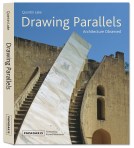
Foreword to Drawing Parallels: Architecture Observed

As you read this, look about you. Note the shapes and functions that surround you, the squares and right angles, the circles and cylinders, the coarse surfaces and the fine finishes. Try naming those materials – animal, vegetable, mineral.

The earliest ideas for Drawing Parallels were first generated by Quintin Lake over ten years ago when I happened to see a draft for a glossary of structures, buildings and architectural eventuality.

Even at that time, when a young student, Lake’s desire to steer the compendium of his experience towards fresh audiences showed an exceptional clarity of purpose. I was struck by the way that all his images emerged from travel and encounter and articulated real experience in real time and space. Real conditions, real weather and real seasons. I remember thinking that perhaps the images could one day assemble themselves into a magnetic needle which would point a way across the whole puzzling field of cultural energy, the things which humans make and destroy, the things which humans leave behind, and the things which humans come upon. This is something that a good eye and a commitment to travel, not tourism, can set in motion.

The camera is a strange editorial tool – the world of ‘seeing’ has no edges, no right angles, only the marvels of peripheral vision and the edginess which is the gift of being human, that sensation of being curious and always wanting to know more than we can see. In English, this mongrel language, we are as likely to begin sentences with‘I think…’as with‘I feel…’ and we often show our understanding of others by saying ‘I see’. The camera can do none of this but editorial intelligence can. Our ability to do things comes as much from the gift of sight as from the capacity for thought. The eye, like the camera may be ‘stupid’, but it is the owner of the eye who makes ‘pictures’.

Seeing, looking, watching, eyeing, observing, noticing, witnessing – together they add up to a prodigious critical process, one of the great things that all humans share. With the eye of Quintin Lake, you are reminded to look up.

He alerts you to both meanings, not just the spatial one,‘looking upwards’, but also the pleasurable pursuit of information, or the tracking down of an acquaintance, whether a person, a building, or a space. He reminds you that the past is turning into the future. One verb, associated with vigilance, slips into a noun to remind us of the biggest question of all – time. In English, we may ‘watch’, but we also may wear one.

The object which you hold is another of those small, portable, architectural marvels – a book. A cousin of the hinge (and so a relation of both the door and the window) it pivots on its spine and allows a furling process, of befores and afters, of images and type, set in sequences that mirror, remind and rehearse. The reader (we don’t say ‘looker’) brings to a book his own special powers of intervention and interpretation, moving back and forth through the territory before him. This too is how we become spatially intelligent, coursing to and fro in cities and beyond, acquiring our own thesaurus of spaces and places, as much as we map a sense of ourselves as temporary occupants of the world. We discover our ‘whereabouts’ surrounded by our ‘belongings’. We learn to‘belong’.

All those questions of utility and serviceability, which architecture and urbanism can never escape, are played out in the utensils which populate our lives. Many of these mini architectures come with ‘directions for use’, whose counter-intuitivity thwarts and frustrates us.

Drawing Parallels is itself a utensil of a special kind, an un-guide book where the imagination which we associate with the promise of all books is the primary agent for giving directions. Drawing Parallels honours and dignifies the pleasure of inhabiting a haptic world. Its comparisons remind us how we come to differentiate between things, how we sort and re-sort. These multiple acts of recognition, which we store in our own reservoirs of experience, overflow into fresh conversations we come to share. It’s unstoppable.

Text © Richard Wentworth, 2009

First Chapter Extract>

Archidose is a “A Daily Dose of Architecture”, a popular blog about architecture from New York City.

Read the post on Holiday Gift Books about Architecture featuring Drawing Parallels here

Gift book for Architects, Engineers, Architecture Students, Travellers and those who love Architecture.

Buy Drawing Parallels: Architecture Observed from Amazon UK here