Archives for category: Documentary Photography

Oxford Shark. Fibreglass shark sculpture erected in 1986. Photo: Quintin Lake

Architectural Photography of the Oxford Shark. Fibreglass shark sculpture erected in 1986, on the 41st anniversary of the dropping of the first atomic bomb. Created by sculptor John Buckley for Bill Heine, who lives in the house. Neighbours tried to force Heine to remove the shark, but after an appeal to the UK’s Secretary of State for the Environment, it was allowed to remain. Oxford, England, 2009

View more / Buy Prints / License Stock images from this photoshoot here

More Stock Photography of Oxford

Photography © Quintin Lake, 2010

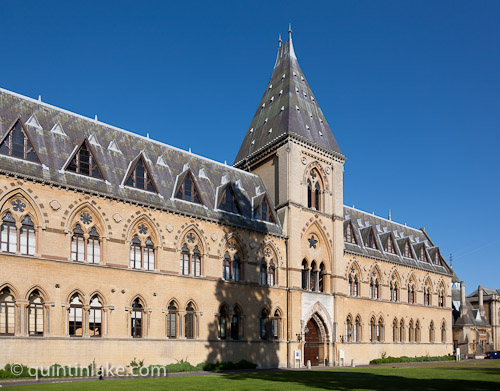
The Oxford University Museum of Natural History designed by Thomas Newenham Deane and Benjamin Woodward in 1850. Photo: Quintin Lake

Unfinished sculpture on the facade of The Oxford University Museum. Photo: Quintin Lake

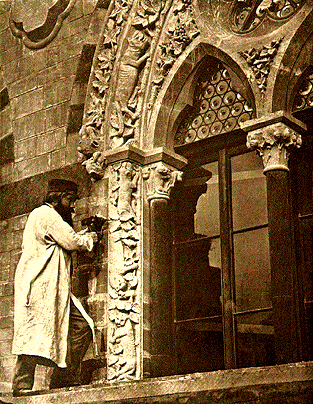
James O'Shea working on the Oxford Natural History Museum 1858, photo attr to Henry Acland

Architectural photography of the Oxford University Museum of Natural History designed by Thomas Newenham Deane and Benjamin Woodward in 1850 influenced by the writings of critic John Ruskin.

View more / Buy Prints / License Stock images from this photoshoot here

More Stock Photography of Oxford

Photography © Quintin Lake, 2010

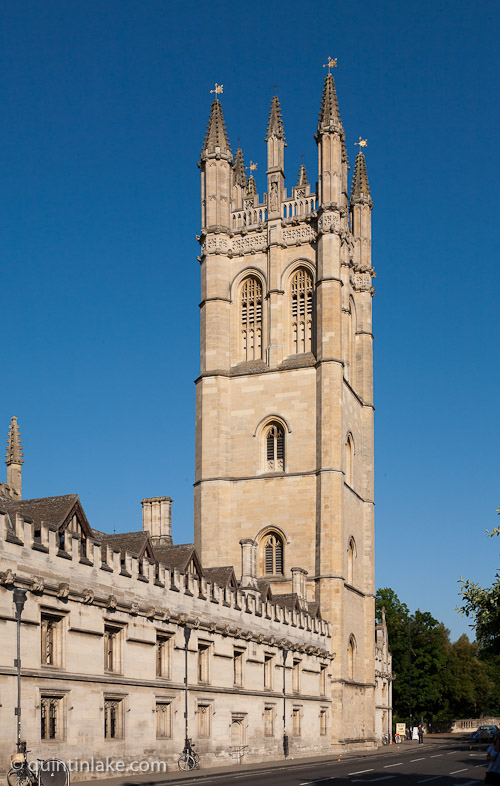
Magdalen Tower, Oxford. Photo: Quintin Lake

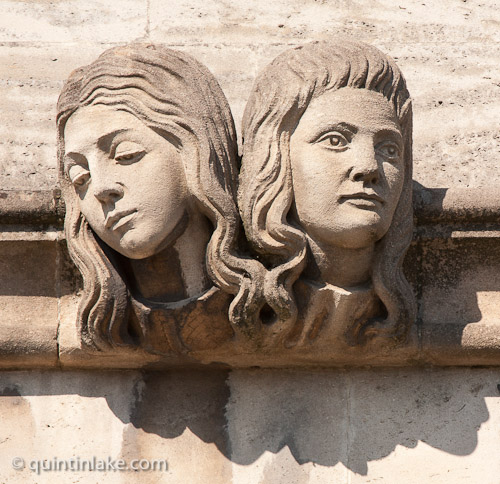
Two women headed Gargoyle below Magdalen Great Tower, Oxford. Photo: Quintin Lake

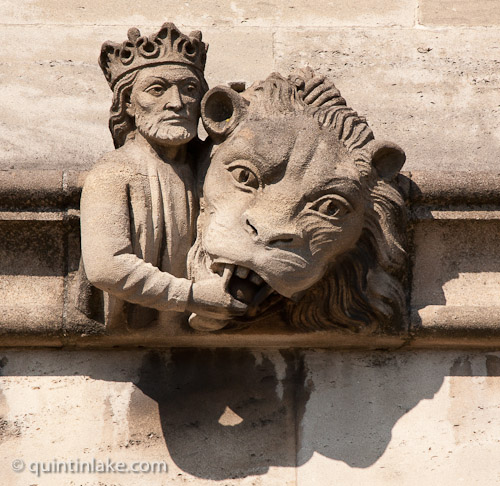
King and Lion Gargoyle below Magdalen Great Tower, Oxford. Photo: Quintin Lake

Architectural Photography of  Magdalen Great Tower is a bell tower in Oxford, England. It is one of the oldest parts of Magdalen College, Oxford, situated directly in the High Street. Built of stone from 1492, when the foundation stone was laid, its bells hung ready for use in 1505, and completed by 1509, it is an important element of the Oxford skyline. At 144 feet (44 m) high to the top of its pinnacles, it is the tallest building in Oxford. It dominates the eastern entrance to the city, towering overMagdalen Bridge and with good views from the Botanic Garden opposite.

View more / Buy Prints / License Stock images from this photoshoot here

More Stock Photography of Oxford

Photography © Quintin Lake, 2010

Aerial view of the centre of Oxford. Photo: Quintin Lake

Aerial view of the centre of Oxford, which has a population of 165,000. Many of the buildings are part of Oxford University, the oldest university in the English speaking.world. They are recognisable by the golden Cotswold limestone and private Quads (an abbreviation of quadrangle), used to describe a college court completely surrounded by buildings and approached through a gateway. Oxford, UK, 2004

View more / Buy Prints / License Stock images from this photoshoot here

More Stock Photography of Oxford

Photography © Quintin Lake, 2010

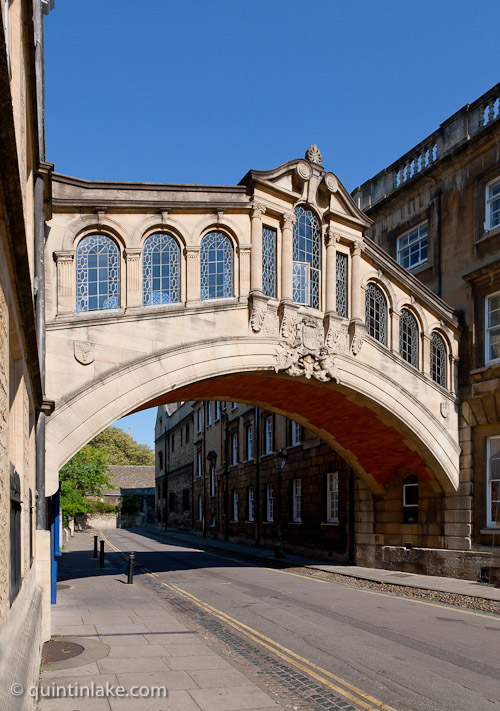
Bridge of Sighs, or Hertford Bridge in Oxford a pedestrian bridge linking together the Old and New Quadrangles of Hertford College. Built 1913. Architect: Sir Thomas Jackson. Photo: Quintin Lake

Architectural Photography of the Bridge of Sighs, or Hertford Bridge in Oxford a pedestrian bridge linking together the Old and New Quadrangles of Hertford College. Built 1913. Architect: Sir Thomas Jackson

View more / Buy Prints / License Stock images from this photoshoot here

More Stock Photography of Oxford

Photography © Quintin Lake, 2010

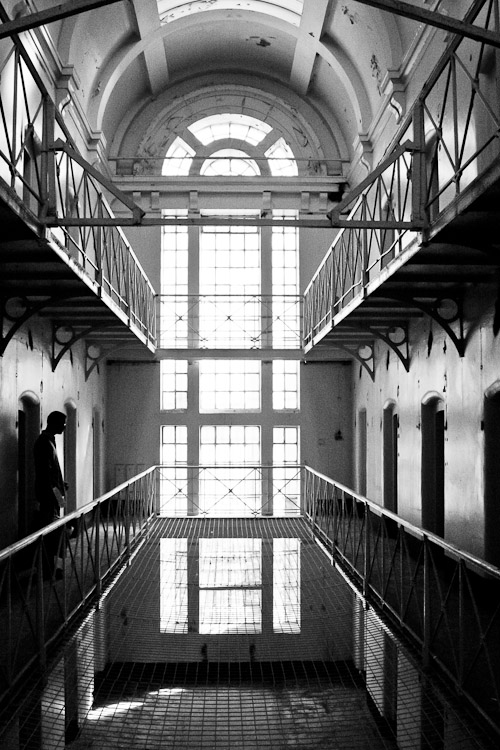
Oxford Prison "A" Wing part of Oxford Castle in August 2004 on the last Open Day before redevelopment as Malmaison hotel (Photo: Quintin Lake)

Oxford Prison was built in 1870. A product of Victorian enlightenment, all the cells had windows, and its massive central gallery (A Wing) — three tiers of cells — was brightened by sunlight pouring through three-storey-tall, barred casement windows. If you’re a fan of British television and movies, you’ll recognize A Wing from episodes of the Oxford-based Inspector Morse, series or from the 1969 version of The Italian Job.

In its day, Oxford Prison was considered airy, healthful, and light. But when the prison closed in 1996 it was so overcrowded that prisoners were apportioned three to a cell. Nevertheless, the once-revolutionary design qualified parts of the building for coveted protection status. Malmaison, which has earned a reputation for converting unusual city center locations into luxury hotels, was one of the few companies willing to take on a project that involved keeping A Wing virtually intact.

These photos were taken on the last Open Day before the Oxford Prison site closed for redevelopment in 2004 before reopening as a Hotel, Malmaison Oxford.

From Wikipedia : “The county gaol gradually grew to take over most of the site. In 1888 it became HM Prison Oxford (Oxford Prison). The prison was closed in 1996 and the site reverted to Oxfordshire County Council. It has since been redeveloped as a shopping and heritage complex, with open courtyards for markets and theatrical performances. The scheme also includes a hotel in the Malmaison chain, Malmaison Oxford, occupying a large part of the former prison block, with converted jail cells as guest rooms. This is the first time in the UK that a prison has been turned into a hotel. The redeveloped site also includes apartments, bars, restaurants, events venues, and a visitor centre operating as “Oxford Castle–Unlocked”

View / Buy more images from this photoshoot here

Photography © Quintin Lake, 2010

Updated: Image Archive featuring over 6,000 Architectural & Fine Art images available for immediate download, license and print purchase

I’ve just completed a major overhaul to my archive website which now contains over 6,000 of my Architectural & Fine Art photographs for sale as prints or download. The website is based on Photoshelter and is used to deliver images to my clients securely, archive my work and integrate commerce. Hope you like it!

Vist the new site here >>

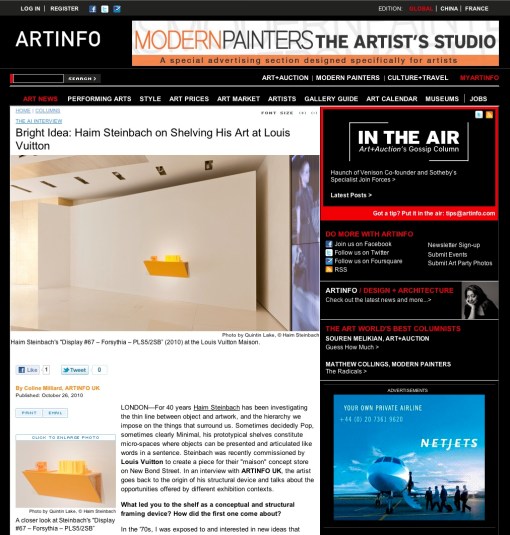
Bright Idea: Haim Steinbach on Shelving His Art at Louis Vuitton

Photography by Quintin Lake © Haim Steinbach Goto Artinfo Article

View more images of Steinbach’s Installation at Louis Vuitton Maison here