Archives for category: Assignments

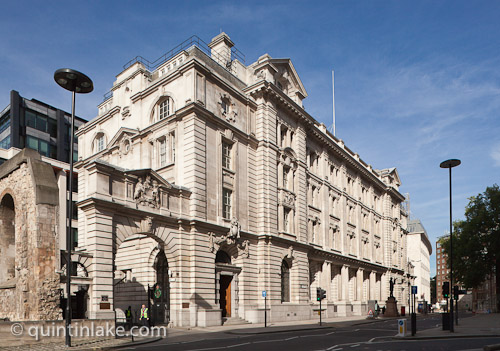
Ironmongers' Livery Company Hall, situated between the Barbican and the museum of London, London (Photo: Quintin Lake)

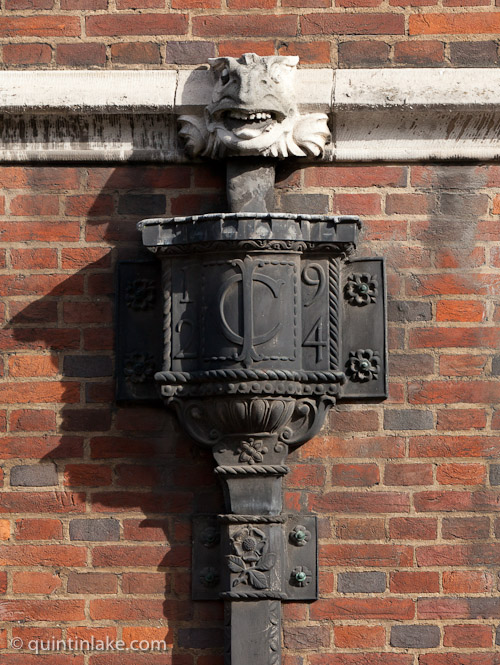
Detail of down-pipe at Ironmongers' Hall, Barbican, London (Photo: Quintin Lake)

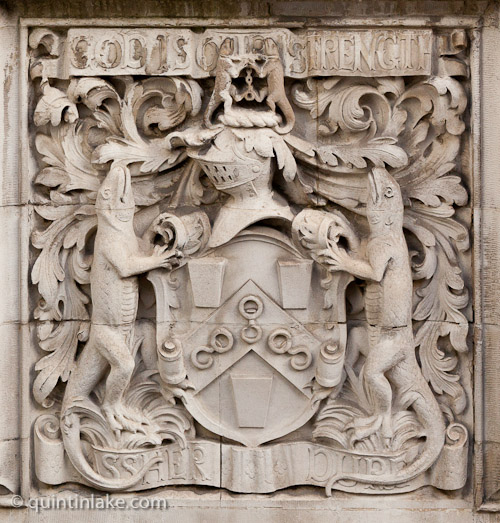
The crest of the Worshipful Company of Ironmongers above the entrance (Photo: Quintin Lake)

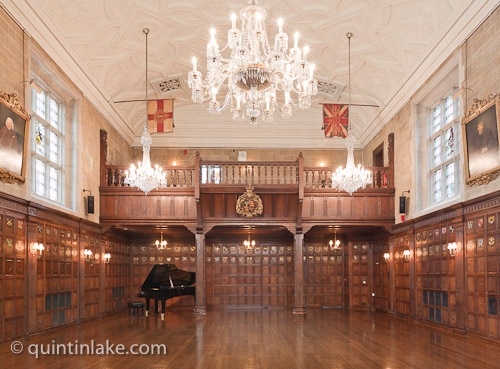
The main banqueting hall in Ironmongers' Hall with with Waterford chandeliers from previous building (Photo: Quintin Lake)

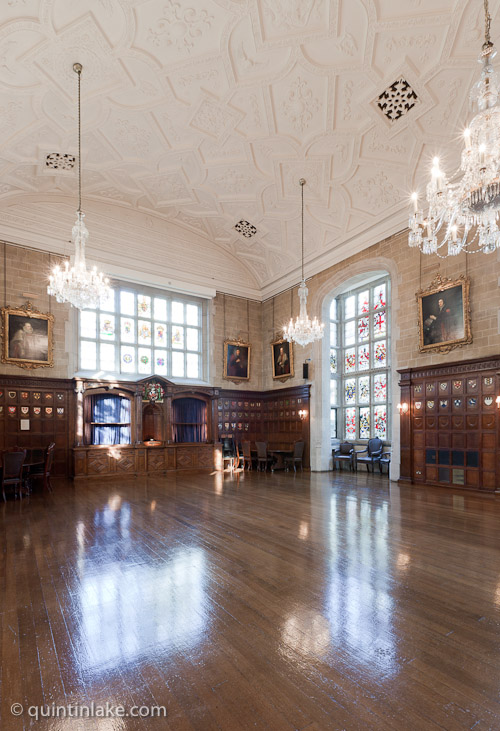
Main Hall of the Jacobean style Ironmongers' Hall, Barbican, London (Photo: Quintin Lake)

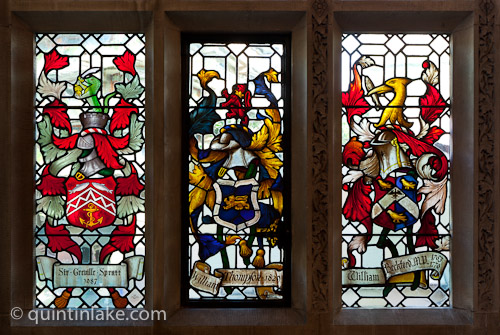
Stained Glass in Main Hall of the Ironmongers' Hall, Barbican, London (Photo: Quintin Lake)

One of Livery Companies of the the of City London, the Ironmongers purchased their first hall in Fenchurch Street in 1457. This was rebuilt by Elias Jarman in 1587 and survived the Great Fire but their third hall of 1745 was one of the few buildings to be bombed in the First World War. The present day Ironmongers’ Hall built in 1925 had a close shave during the incendiary raids of the Second World War in December 1940 when heat melted window glass and lead & asphalt on the roof but the occupants managed to save the building with the use of stirrup pumps.

The present hall was constructed in in a Neo-Tudor style by architect Sydney Tatchell on a site previously occupied by tenement houses, pulled down in 1910. Much of the craftwork being done by hand which is of a fantastic quality which prevents the building feeling like a pastiche despite being built around a steel frame. The banqueting hall is of double height with Waterford chandeliers of 1803 from the previous hall. Today the building sits unexpectedly between the museum of London and the Barbican which adds to its charm making the vistor feel they have discovered something hidden

The hall features as a location on the DVD of  Harry Potter and the Goblet of Fire.

See the Ironmongers’ Hall website for information on hiring the venue.

These photographs were commissioned by Thames & Hudson / View Pictures for an upcoming book on the architecture of the City of London

View more images of Ironmongers’ Hall here

Photography © Quintin Lake, 2010

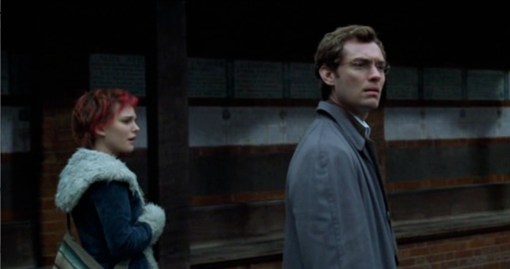
Alice Ayres (Natalie Portman) & Dan Woolf (Jude Law) in front of Memorial to Heroic Self Sacrifice in the movie Closer
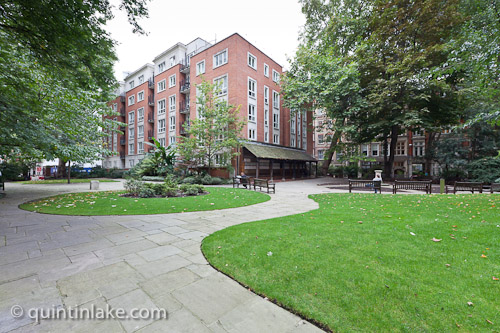
Postman's Park located between St Martin’s le Grand and King Edward Street in the City of London (Photo: Quintin Lake)
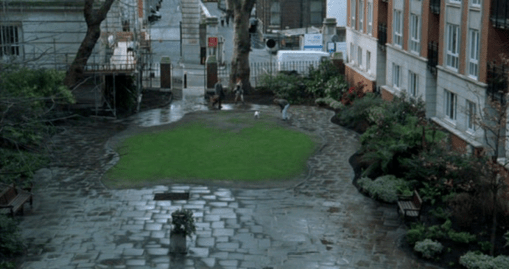
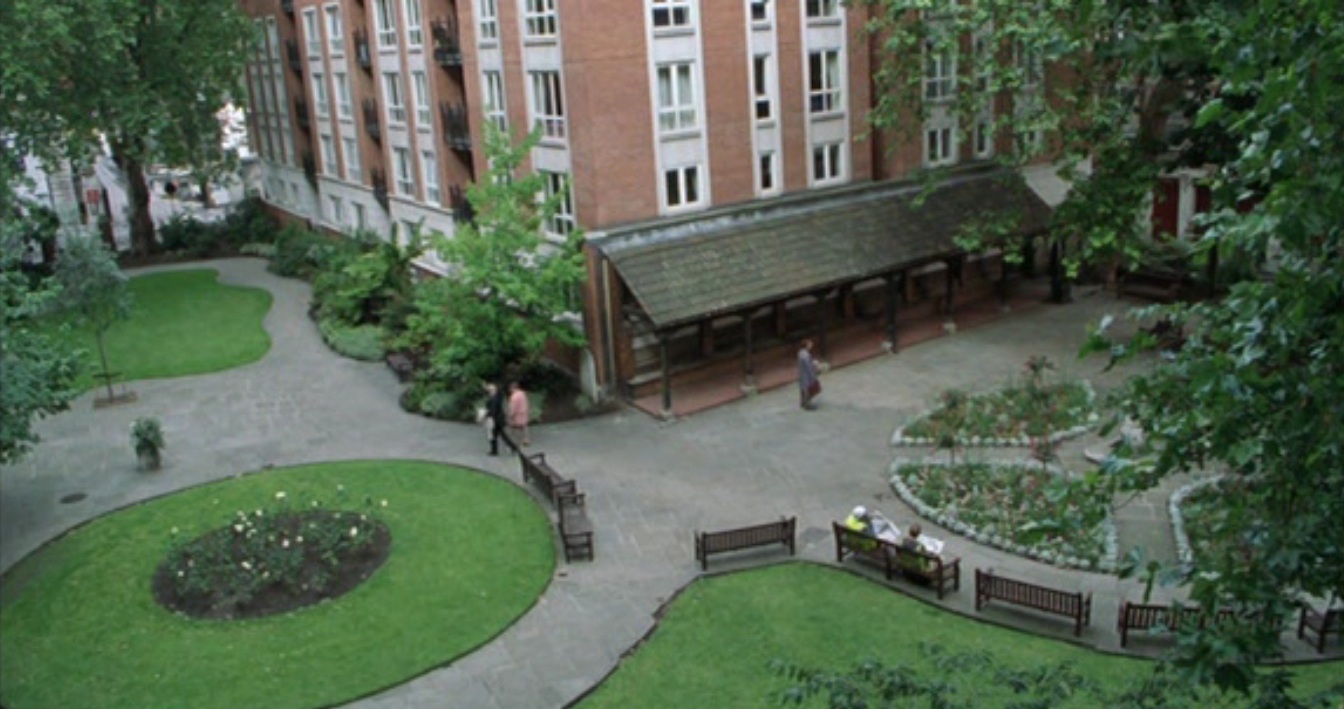
Alice Ayres (Natalie Portman) & Dan Woolf (Jude Law) enter Postman's park in the movie Closer
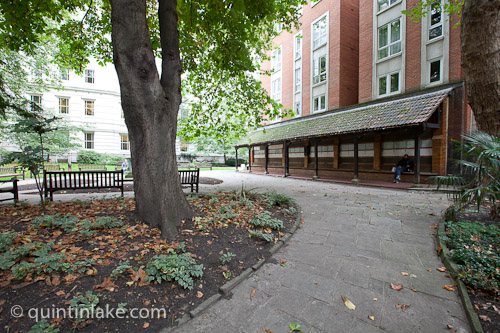
Postman's Park view of the loggia that makes up the Memorial to Heroic Self Sacrifice , City of London (Photo: Quintin Lake)
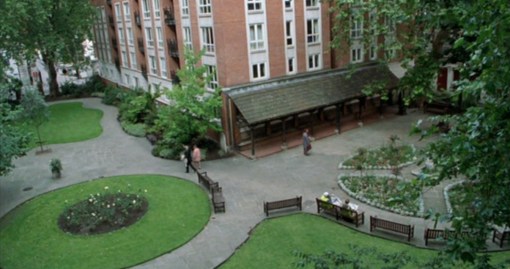
Dan Woolf (Jude Law) returns to the Memorial in Postman's Park at the end of the film Closer
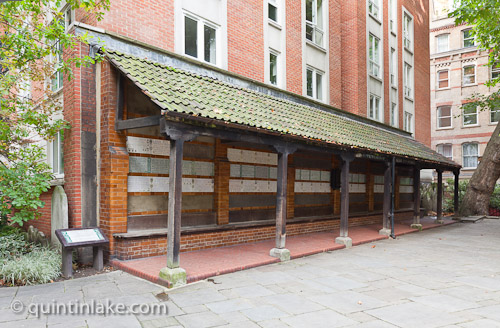
Memorial to Heroic Self Sacrifice Loggia in Postman's Park, City of London (Photo: Quintin Lake)

"In commemoration of Heroic Self Sacrifice" Postman's Park, City of London (Photo: Quintin Lake)
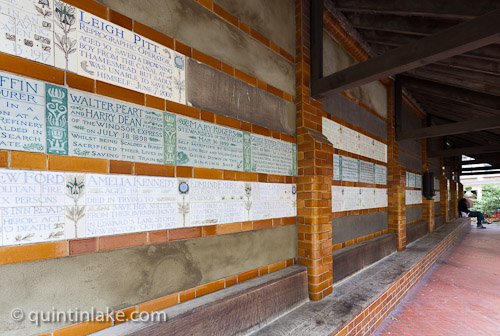
Arrangement of the tiles in the Memorial to Heroic Self Sacrifice, Postman's Park, City of London (Photo: Quintin Lake)

Statue of George Frederic Watts by T. H. Wren inscription reads "The Utmost for the Highest" "In memorial of George Frederic Watts, who desiring to honour heroic self-sacrifice placed these records here" (Photo: Quintin Lake)

1900 tile by William De Morgan. one of the first to be installed "Walter Peart, Driver and Harry Dean, Fireman of the Windsor Express on July 18 1898 Whilst being scalded and burnt sacrificed their lives in saving the train" (Photo: Quintin Lake)
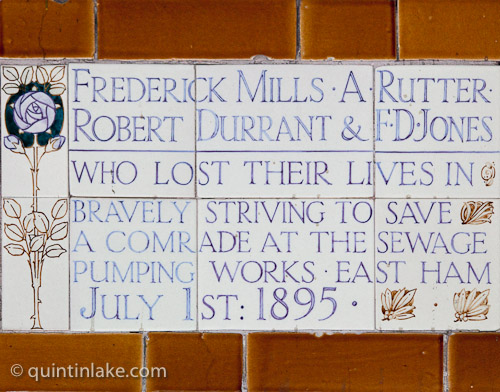
1902 tile by Royal Doulton "Frederick Mills · A Rutter Robert Durant & F D Jones Who lost their lives in bravely striving to save a comrade at the Sewage Pumping Works East Ham July 1st 1895" (Photo: Quintin Lake)

1902 tile by William De Morgan "Alice Ayres Daughter of a bricklayer's labourer Who by intrepid conduct saved 3 children from a burning house in Union Street Borough at the cost of her own young life April 24 1885" In the movie Closer Alice Ayres is played by Natalie Portman and Dan Woolf by Jude Law who notices this tile which features in the film. (Photo: Quintin Lake)
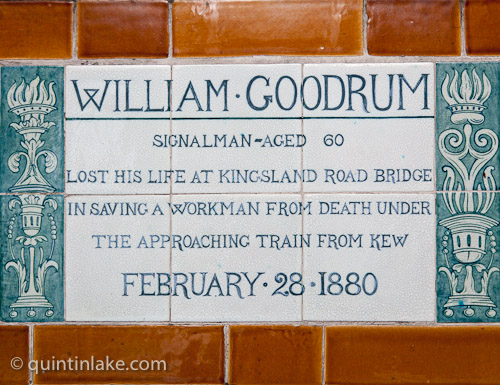
1905 tile by William De Morgam "William Goodrum Signalman · Aged 60 Lost his life at Kingsland Road Bridge in saving a workman from death under the approaching train from Kew February 28 1880" (Photo: Quintin Lake)

1908 tile by Royal Doulton "Thomas Simpson Died of exhaustion after saving many lives from the breaking ice at Highgate Ponds Jan 25 1885" (Photo: Quintin Lake)

1930 tile by Royal Doulton "P.C. Percy Edwin Cook Metropolitan Police Voluntarily descended high-tension chamber at Kensington to rescue two workmen overcome by poisonous gas" (Photo: Quintin Lake)
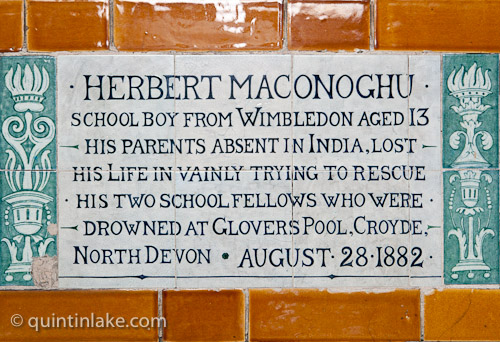
1931 tile by Fred Passenger "Herbert Maconoghu School boy from Wimbledon aged 13 His parents absent in India, lost his life in vainly trying to rescue his two school fellows who were drowned at Glovers Pool, Croyde, North Devon August 28 1882" (Photo: Quintin Lake)
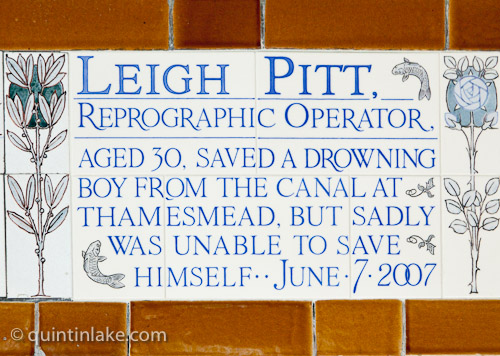
the most recent 2009 tile by Craven Dunnill Jackfield Ltd "Leigh Pitt Reprographic operator Aged 30, saved a drowning boy from the canal at Thamesmead, but sadly was unable to save himself" (Photo: Quintin Lake)

Postman’s Park is hidden away park in central London, a short distance north of St Paul’s Cathedral. Bordered by Little Britain, Aldersgate Street, King Edward Street, and the site of the former head office of the General Post Office (GPO), it is one of the largest parks in the City of London, the walled city which gives its name to modern London. A shortage of space for burials in London meant that corpses were often laid on the ground and covered over with soil instead of being buried, and thus Postman’s Park, built on the site of former burial grounds, is significantly elevated above the streets which surround it. It is best known as the location of the Memorial to Heroic Self Sacrifice.

Opened in 1880 on the site of the former churchyard and burial ground of St Botolph’s Aldersgate church, it expanded over the next 20 years to incorporate the adjacent burial grounds of Christ Church Greyfriars and St Leonard, Foster Lane, as well as the site of housing demolished during the widening of Little Britain in 1880, the ownership of which became the subject of a lengthy dispute between the church authorities, the General Post Office, the Treasury, and the City Parochial Foundation. The park’s name reflects its popularity amongst workers from the nearby GPO’s headquarters.

In 1900, the park became the location for George Frederic Watts’s Memorial to Heroic Self Sacrifice (also known as the Wall of Heroes), a memorial to ordinary people who died saving the lives of others and might otherwise have been forgotten, in the form of a loggia and long wall housing ceramic memorial tablets. At the time of its opening, only four of the planned 120 memorial tablets were in place, with a further nine tablets added during Watts’s lifetime. Following Watts’s death in 1904, his wife Mary Watts took over the management of the project and oversaw the installation of a further 35 memorial tablets in the following four years, as well as a small monument to Watts. However, disillusioned with the new tile manufacturer and with her time and money increasingly occupied by the running of the Watts Gallery, Mary Watts lost interest in the project and only five further tablets were added during her lifetime.

Although Watts’s plans for the memorial had envisaged names inscribed on the wall, in the event the memorial was designed to hold panels of hand-painted and glazed ceramic tiles. Watts was an acquaintance of William De Morgan, at that time one of the world’s leading tile designers, and consequently found them easier and cheaper to obtain than engraved stone.

In 1972, key elements of the park, including the Memorial to Heroic Self Sacrifice, were grade II listed to preserve their character. Following the 2004 film Closer, based on the 1997 play Closer by Patrick Marber, Postman’s Park experienced a resurgence of interest; key scenes of both were set in the park itself. In June 2009 the Diocese of London added a new tablet to the Memorial in the style of the Royal Doulton tiles for Leigh Pitt, a print technician from Surrey, had died on 7 June 2007 rescuing nine-year-old Harley Bagnall-Taylor who was drowning in a canal in Thamesmead. This tile the first new addition for 78 years and the 54th tablet

These photographs were commissioned by Thames & Hudson / View Pictures for an upcoming book on the architecture of the City of London

View more images of Postman’s Park and all 54 tiles in the  Memorial to Heroic Self Sacrifice, London here

Photography © Quintin Lake, 2010

King Edward Buildings (former General Post Office Headquarters) now Bank of America Merrill Lynch London Headquarters. Architect: Sir Henry Tanner (Photo: Quintin Lake)

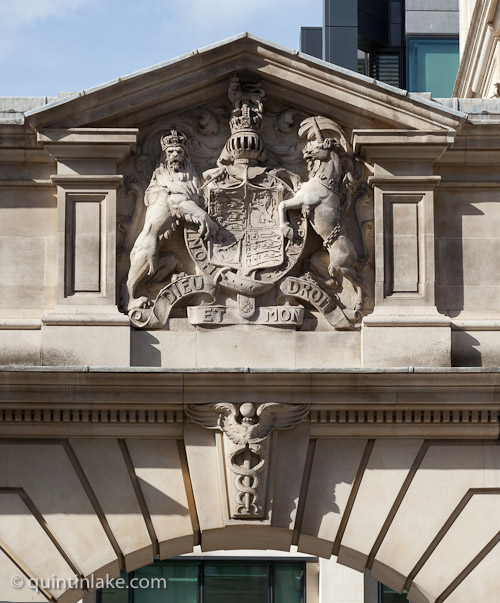
Coat of arms of Edward VII of the United Kingdom above the coach entrance to the King Edward Buildings. The instription Dieu et mon droit is the french motto of the British Monarch meaning "God and my right shall me defend" (Photo: Quintin Lake)

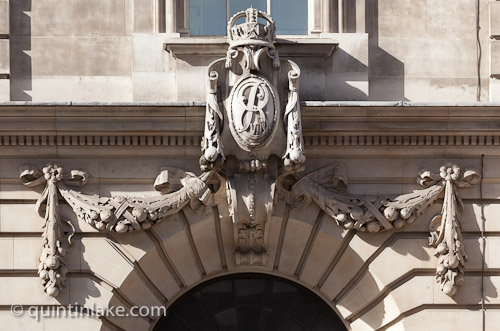
King Edward VII portland stone ornamentation with ERVII lettering above the window King Edward Buildings (Photo: Quintin Lake)

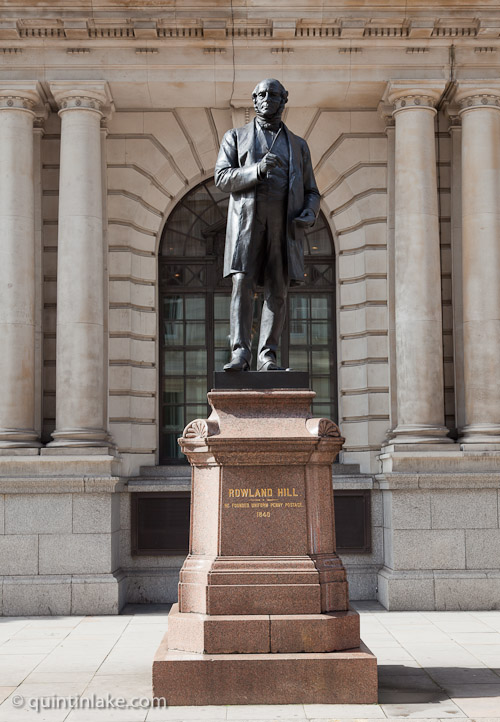
Statue by Onslow Ford of Rowland Hill, with the inscription "HE FOUNDED UNIFORM PENNY POSTAGE 1840" outside the King Edward Buildings (Photo: Quintin Lake)

The King Edward Buildings on the west Side of King Edward Street in the City of London, now part of the Bank of America Merrill Lynch London Headquarters, is one of the remaining buildings of the former General Post Office Headquarters the other being The North Range, now named Namura House across the street.

Built 1907-1911 to the designs of Sir Henry Tanner, architect of the Office of Works. An early example of the use of reinforced concrete construction the building has stronger accents as was fashionable in the Edwardian period  than The North Range (Now named Namura House) over the road completed two years previously. The facade of the building has various ornamental motifs celebrating King Edward VII from which the street takes its name. King Edward Street was known as Butchers Hall Lane until 1843.

In front of the building is a statue by Onslow Ford of Rowland Hill the postal reformer, with the inscription “HE FOUNDED UNIFORM PENNY POSTAGE 1840”

These photographs were commissioned by Thames & Hudson / View Pictures for an upcoming book on the architecture of the City of London

View more images of the King Edward Buildings Here

Photography © Quintin Lake, 2010
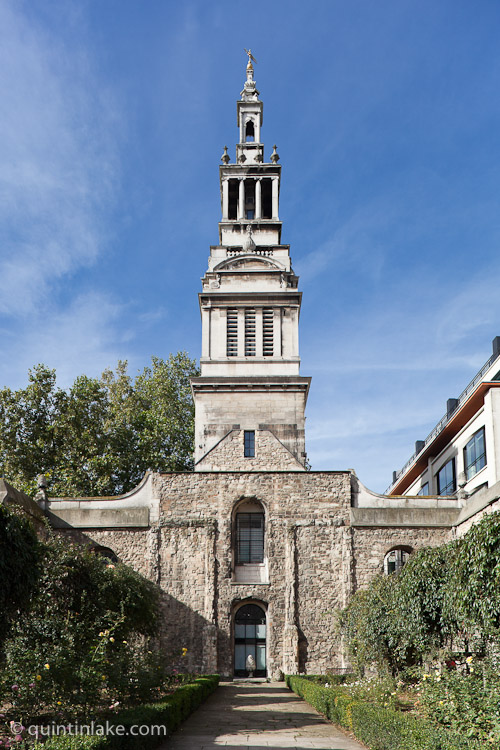
Blitz damaged nave and steeple of Christ Church Greyfriars, by Christopher Wren in the City of London. The tower, rising from the west end of the church, had a simple round-arched main entranceway and, above, windows decorated with neoclassical pediments. Large carved pineapples, symbols of welcome, graced the four roof corners of the main church structure. Unique among the Wren churches, the east and west walls had buttresses. (Photo: Quintin Lake)

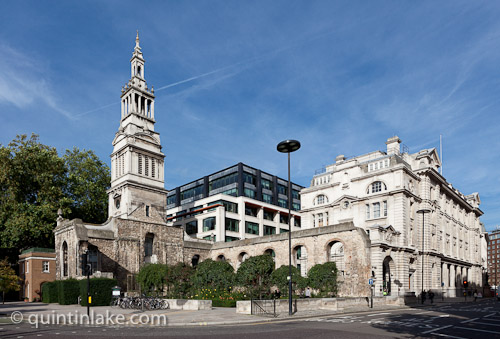
Remains of the Second World War damaged nave of Christ Church Greyfriars, London by Christopher Wren, 1687. Former General Post office buildings at right, now Merrill Lynch regional headquarters, contemporary Merrill Lynch offices at rear. (Photo: Quintin Lake)

Christ Church Greyfriars, also known as Christ Church Newgate, was an Anglican church located at the junction of Newgate Street and Montague Street, opposite St Paul’s Cathedral in the City of London. Built first in the gothic style, then in the English Baroque style by Sir Christopher Wren in 1687, it ranked among the City’s most notable pieces of architecture and places of worship.

The church was destroyed in the Second World War during the Blitz on December 29, 1940. A firebomb struck the roof and tore into the nave. Much of the surrounding neighbourhood was also set alight—a total of eight Wren churches burned that night. At Christ Church, the only fitting known to have been saved was the cover of the finely carved wooden font, recovered by an unknown postman who ran inside as the flames raged. The roof and vaulting collapsed into the nave; the tower and four main walls, made of stone, remained standing but were smoke-scarred and gravely weakened. A photograph taken in the light of the following day shows two firemen hosing down smouldering rubble in the nave. The ruins are now a public garden.

In 2002, the financial firm Merrill Lynch completed a regional headquarters complex on land abutting to the north and the west. In conjunction with that project, the Christ Church site got a major renovation and archeological examination. Construction workers put King Edward Street back to its former course so that the site regained its pre-war footprint. The churchyard was spruced up, its metal railings restored. In 2006, work was completed to convert the tower and spire into a modern twelve-level private residence. The nave area continues as a memorial; the wooden font cover, topped by a carved angel, can today be seen in the porch of St Sepulchre-without-Newgate.

These photographs were made during a commission by Thames & Hudson / View Pictures for a book on the architecture of the City of London.

View more images of Christ Church Greyfriars Here

Photography © Quintin Lake, 2010
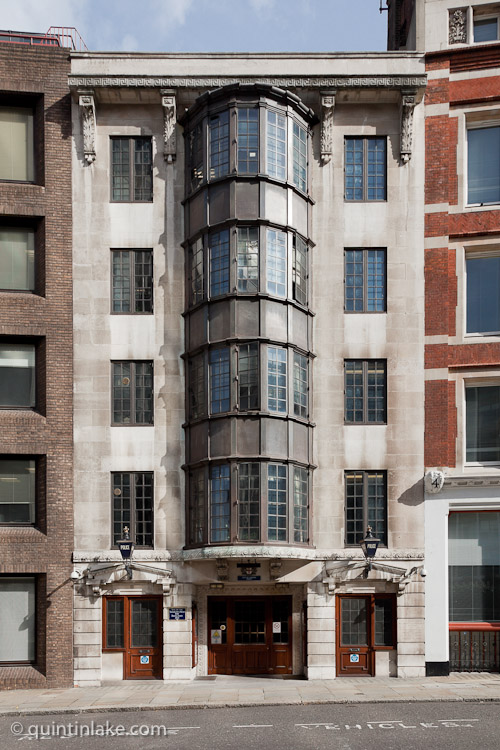
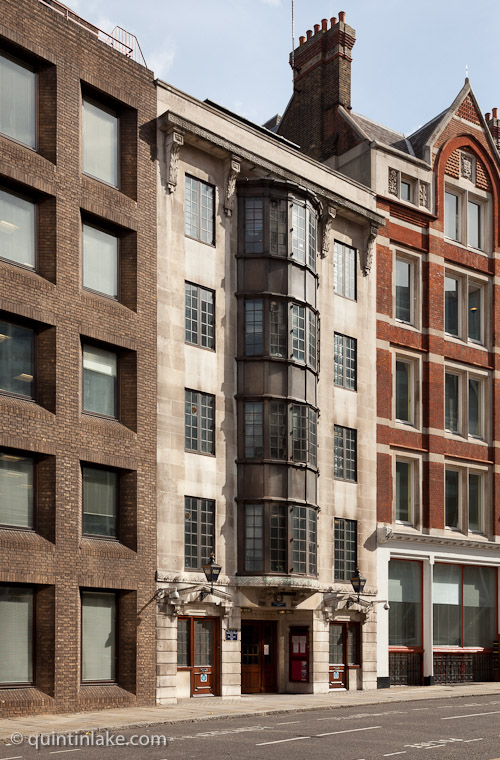
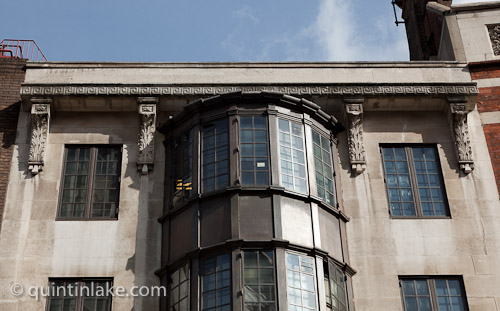
Front elevation of Snow Hill Police Station by Sydney Perks, 1926 (Photo: Quintin Lake)

Snow Hill Police at 5 Snow Hill in the City of London (Photo: Quintin Lake)

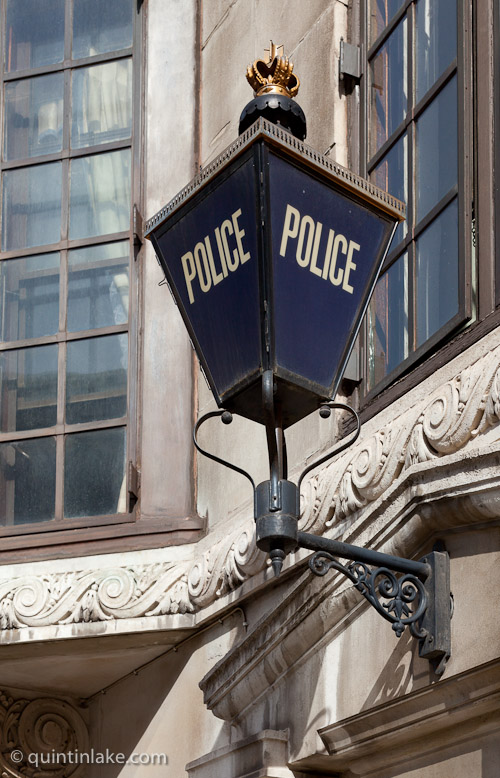
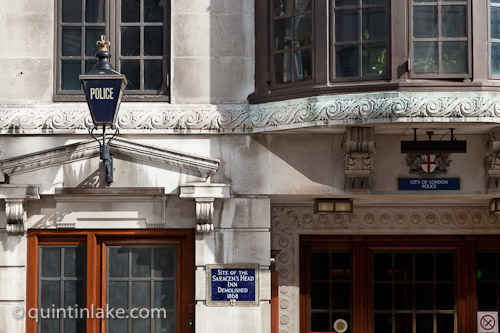
Police lanterns at Snow Hill Police Station (Photo: Quintin Lake)

Cornice cut in a Meander pattern and supported by long acanthus brackets at Snow Hill Police Station (Photo: Quintin Lake)

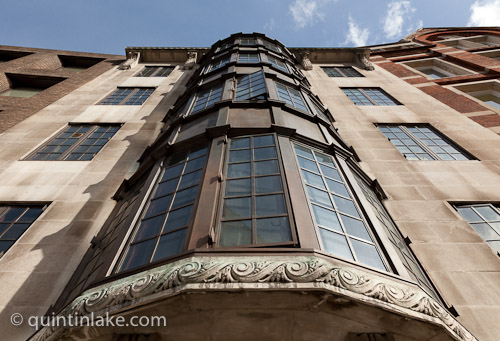
The elegant metal full-height polygonal bay of five windows at Snow Hill Police Station with Guilloche interlace pattern (Photo: Quintin Lake)

Snow Hill Police Station showing City of London plaque to the Saracen's Head, demolished in 1868 (Photo: Quintin Lake)

Snow Hill Police Station, a 24 hour operational station of the City of London Police. The police station was built on the site of the former Saracen’s Head Inn that was demolished in 1868, and a plaque on the wall outside records that fact.

The building merits Grade II Listed Building status, and the English Heritage website page describes it thus:

Police Station. 1926 by Sydney Perks. Stone with lead to bay; roof of slate. Five storeys over basement. Three-window range. All opening flat arched. Noteworthy and unusual blend of Modern and Arts and Crafts style. Banded rustication to ground floor with three doors, those to sides with one sidelight each, that to centre at rear of rectangular recess set under a full-height polygonal bay of five windows with Tuscan pilaster responds and a cornice at the top cut in a Meander pattern and having long acanthus brackets. Running guilloche to ground floor. Plain parapet with coping. Ornaments are judiciously placed to emphasise the simple expanse of masonry and the elegant metal-faced bay. Police lanterns in parapets over side elevations. City of London plaque to the Saracen’s Head, demolished in 1868.

These photographs were commissioned by Thames & Hudson / View Pictures for a book on the architecture of the City of London

View more images of Snow Hill Police Station Here

Photography © Quintin Lake, 2010
Gary a plumber from G F Cross & Sons installing services below the new servery (Photo: Quintin Lake)

Rich Oliver a carpenter from Benfield & Loxley fabricating new washroom cubicles (Photo: Quintin Lake)

Paul Martin of Polydeck Resins mixes floor sealant in the kitchen (Photo: Quintin Lake)

Matthew a carpenter from Benfield & Loxley works on the new bar area (Photo: Quintin Lake)

Terry & Lloyd from Benfield & Loxley Groundwork Crew (Photo: Quintin Lake)

Ron Cross & Jono of G F Cross & Sons study the services plan (Photo: Quintin Lake)

The new servery next to the main hall starts to take shape (Photo: Quintin Lake)

New bar in the cellars (Photo: Quintin Lake)

October construction progress at Pembroke College, Oxford as part of a larger photographic documentation of the project.

VIEW MORE / BUY PRINTS / LICENSE IMAGES from Pembroke College Hall, Bar and Forte Room Redevelopment here >>

Haim Steinbach by his installation at Louis Vuitton Maison, 2010 (Photography: Quintin Lake)

"Display #67 ‐ Forsythia ‐ PLS5/2SB" by Haim Steinbach at Louis Vuitton Maison, 2010 (Photography: Quintin Lake)

Detail of "Display #67 ‐ Forsythia ‐ PLS5/2SB" by Haim Steinbach at Louis Vuitton Maison, 2010 (Photography: Quintin Lake)

In this installation, entitled Display #67 ‐ Forsythia ‐ PLS5/2SB, Haim Steinbach places two bright yellow safety ‘boots’ next to a yellow laser level, on a yellow plastic laminated, wood shelf, which is attached to a free‐standing wall. Laser beams project from the level in five different directions.

Runs from Tuesday 12th October to Tuesday 26th October 2010 at Louis Vuitton Maison, 17/20 New Bond Street, London, W1S 2RB

Photography commissioned by Calum Sutton PR on behalf of Louis Vuitton images of artwork © Haim Steinbach
View more images of Steinbach’s Installation at Louis Vuitton Maison here

RIBA Downland Joint-Prize Winner | Project: Beard Mill | Architect: Berman Guedes Stretton (Photography: Quintin Lake)

RIBA Ibstock Downland Prize Winner 2008 | Project: Oxford School of Drama | Architect: Berman Guedes Stretton (Photography: Quintin Lake)

The Downland Prize has been awarded every year since 1998 to an architect based in RIBA South East or RIBA South regions, whose project with a total cost of £1million, best demonstrates the benefits of using an architect’s services.

I photographed two projects; Oxford School of Drama and Beard Mill Clinic for Oxford & London based architects Berman Guedes Stretton which both won the RIBA Ibstock Downland prize competition on consecutive years adding to their growing list of awards.

“Quintin has photographed numerous buildings for us over the years, with excellent results. We have used his images for all our marketing documents, and on our website, and they have been central to several of our winning architectural competition submissions: notably, the RIBA South Conservation Award (Oxford University Press – Mailing Shed) and the RIBA Ibstock Downland Prize (Beard Mill).”
Jon Du Croz, Architect, Berman Guedes Stretton

View more photos from the photoshoot at  Oxford School of Drama and Beard Mill Clinic.

Photography © Quintin Lake