Archives for category: Documentary Photography

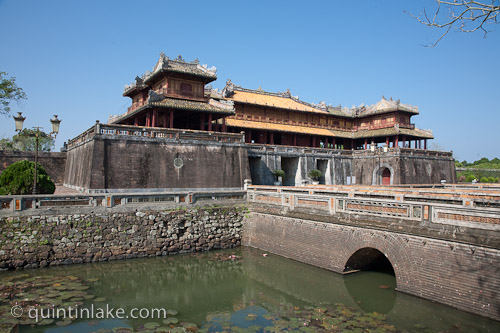
Bridge over the moat leading to Ngo Mon Gate with Five Phoenix Watchtower above, Hue Citadel / Imperial City, Hue, Vietnam

The Ngo Mon Gate is a massive structure in front of the Hue Citadel that also served as a royal viewing platform for court ceremonies. Two of the five entrances that cut through the thick stone ramparts serve as entry and exit points for tourists. The largest, middle gate is barred – reserved for the Emperor’s use. The two entrances flanking the Emperor’s gate were reserved for mandarins and court officials, while the outermost entrances were reserved for soldiers and war materiel.

The “Belvedere of the Five Phoenixes”, the Emperor’s private viewing platform on top of the gate, hosted the emperor and his retinue during important court ceremonies. No women were allowed at this level; from this high vantage point, the Emperor and his mandarins observed military exercises and awarded examination passers.

The platform has also seen its fair share of modern history. It was here that the last Emperor of Vietnam, Bao Dai, abdicated in favor of the revolutionary government headed by Ho Chi Minh, on August 30, 1945.

VIEW IMAGES of Ngo Mon Gate & Five Phoenix Watchtower, Hue

VIEW IMAGES of Hue Citadel & Imperial City, Hue, Vietnam

Photography © Quintin Lake, 2010

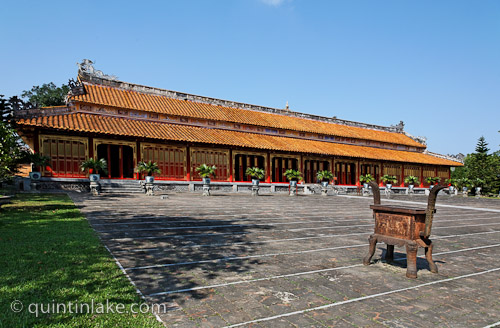
The Mieu Temple devoted to ten Emperors of the Nguyen dynasty, courtyard and Incense burner. Hue Citadel / Imperial City, Hue, Vietnam

On the death anniversaries of the emperors, the reigning emperor and his retinue would perform the appropriate ceremonies at The To Mieu. The lacquered altars in the main gallery each honor one of the Nguyen Emperors. The altars originally numbered only seven – the French overlords prevented the Nguyen emperors from installing altars to honor anti-French emperors Ham Nghi, Thanh Thai, and Duy Tan. The three missing altars were included in 1959, after the departure of the French.

VIEW MORE IMAGES of Mieu Temple, Imperial City, Hue

VIEW IMAGES of Hue Citadel & Imperial City, Hue, Vietnam

Photography © Quintin Lake, 2010
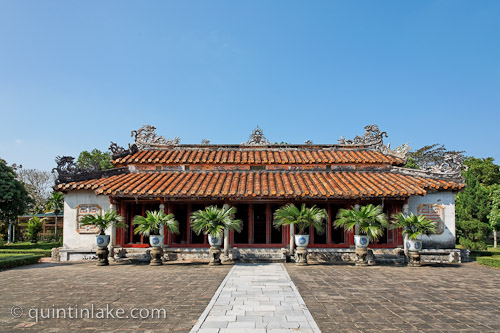
Hung Mieu Temple, Hue Citadel / Imperial City, Hue, Vietnam

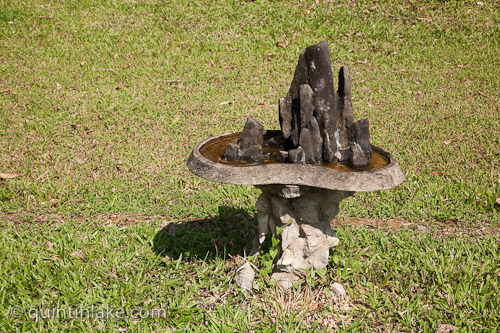
Floating landscape sculpture, Hung Mieu Temple, Hue Citadel / Imperial City, Hue, Vietnam

Located north of the Mieu, Hung Mieu was devoted to the woship of King Gia Long’s parents (Lord Nguyen Phuc Luan and his wife). It was constructed in 1821 by King Minh Mang. Hung Temple as seen today was re-constructed in 1951 by lady Tu Cung (the last queen mother of the Nguyen dynasty), but it’s not according to original architecture.

VIEW MORE IMAGES of Hung Mieu Temple, Imperial City, Hue

VIEW IMAGES of Hue Citadel & Imperial City, Hue, Vietnam

Photography © Quintin Lake, 2010

Gateway to Hien Lam pavilion, Hue Citadel / Imperial City, Hue, Vietnam

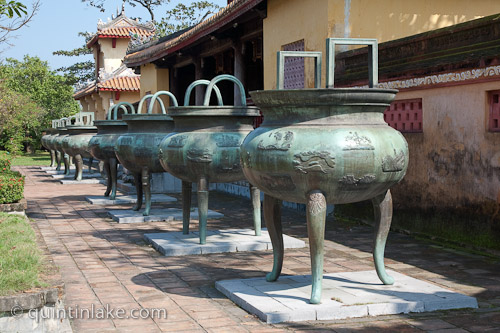
Nine Dynastic Urns, Hue Citadel / Imperial City, Hue, Vietnam

The Hien Lam Cac Pavilion (Pavilion of Everlasting Clarity) was built in 1821-22 in memory of the mandarins who served the Nguyen dynasty. At 13m in height, this is the tallest building in the citadel. In front of the pavilion stand the nine dynastic urns, which were cast in bronze in 1835-37 and which each weigh between 2 and 2.5t. Each urn is dedicated to an emperor, symbolising one of his qualities.

VIEW MORE IMAGES of Hien Lam pavilion & the Nine Dynastic Urns

VIEW IMAGES of Hue Citadel & Imperial City, Hue, Vietnam

Photography © Quintin Lake, 2010
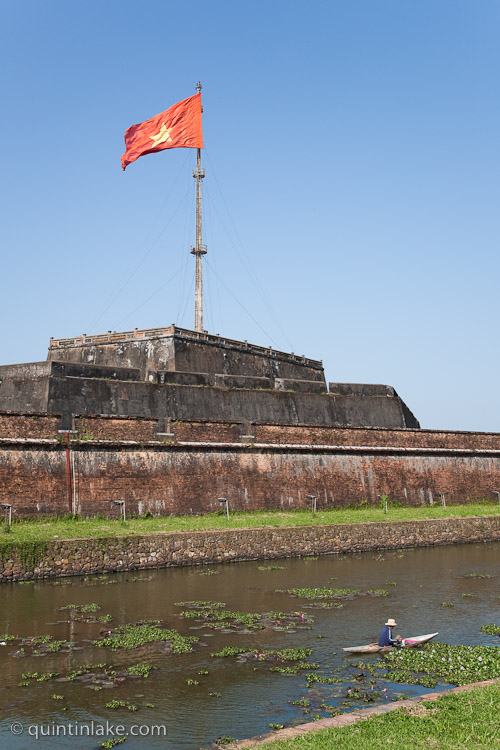
Flag Tower (Cot Co) flying the vietnamese flag above a man in canoe, Hue Citadel / Imperial City, Hue, Vietnam

Looming over the Citadel at a height of 120 ft (37m), the Flag Tower or Cot Co has dominated Hue’s skyline since 1809, when Emperor Gia Long erected it over a big 59 ft brick redoubt. On Jan 31 1968, during the Tet Offensive, Cot Co achieved international recognition when the communist forces seized the Citadel, hoisting the National Liberation Front’s yellowed-starred banner on the Flag Tower’s mast.

VIEW MORE IMAGES of Flag Tower or Cot Co Hue, Vietnam

VIEW IMAGES of Hue Citadel & Imperial City, Hue, Vietnam

Photography © Quintin Lake, 2010
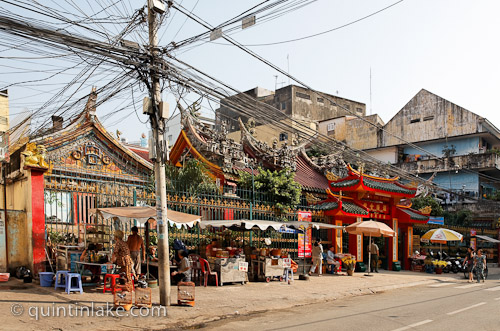
Quan Am Pagoda from the street, Cholon, Ho Chi Minh City

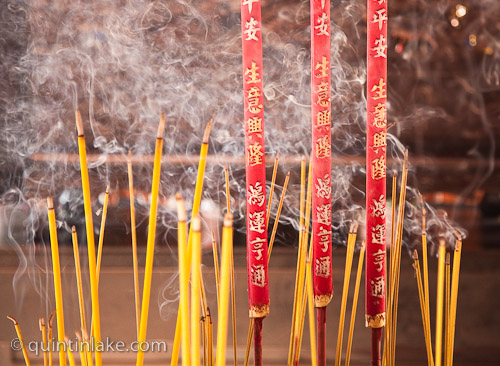
Burning incense sticks and smoke in Quan Am Pagoda, Cholon, Ho Chi Minh City

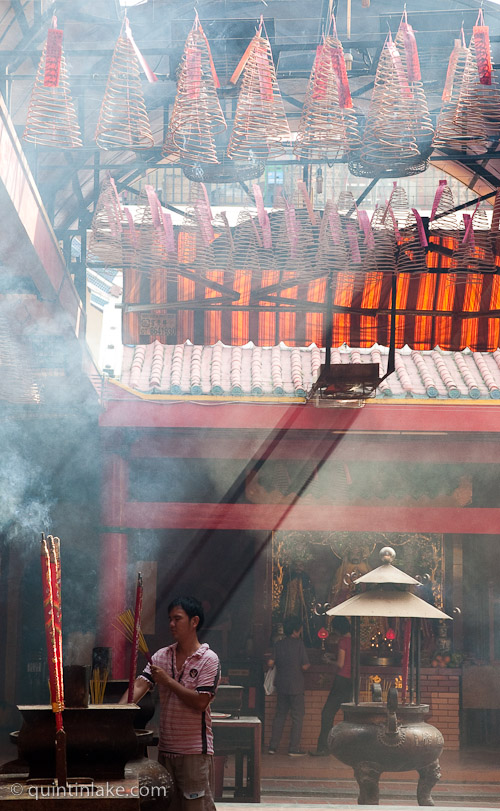
A man prays with incense sticks in a shaft of light in the rear courtyard of Quan Am Pagoda, Cholon, Ho Chi Minh City

Chùa Quan Âm (Avalokiteshvara Pagoda) is a Chinese style Buddhist pagoda located on Lao Tu Street in Cho Lon, District 5, Ho Chi Minh City, Vietnam. Founded in the 19th century, it is dedicated to the bodhisattva Quan Âm (Avalokiteshvara in Sanskrit, Guan Yin in Chinese). The pagoda is very popular among both Vietnamese and Chinese Buddhists. Most of the inscriptions are in Chinese characters, but some labels have been added in Vietnamese. The spirituality of the pagoda is a mixture of Pure Land Buddhism centered on the figure of Amitabha Buddha, special veneration of the female bodhisattva Quan Am, Taoism, and traditional Chinese religion, the latter including the devotion to Thien Hau (the Lady of the Sea) that is so typical of traditionally seafaring Chinese communities of Fukien, Canton, Taiwan, and Southeast Asia.

VIEW MORE IMAGES of Quan Am Pagoda

Photography © Quintin Lake, 2010

Entrance courtyard of Thien Hau Temple, Ho Chi Minh City, Vietnam

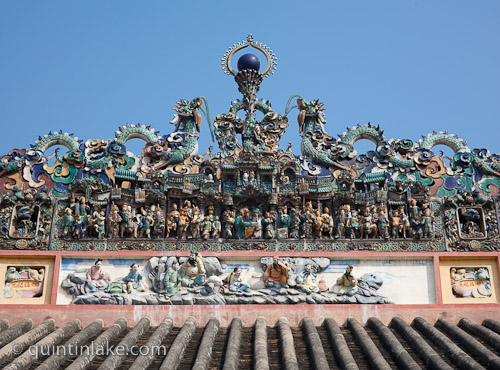
Porcelain dragons and figurines expressing themes from Chinese religion and legends on the roof of Thien Hau Temple, Ho Chi Minh City, Vietnam

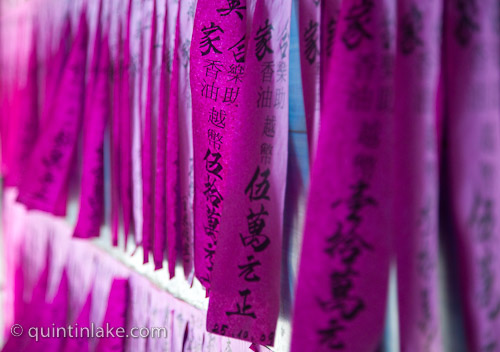
The pink tissue paper prayer flags, contain the names of people who have made donations for the upkeep of the temple, Chua Thien Hau Temple, Ho Chi Minh City, Saigon, Vietnam

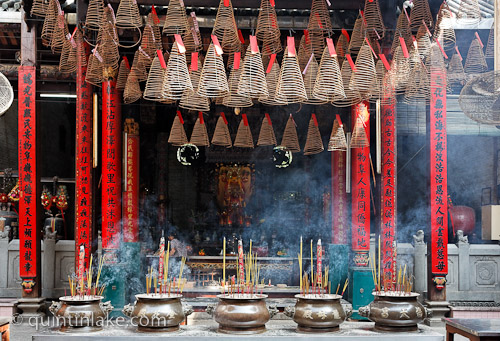
Smoking conical incense coils and urns at Chua Thien Hau Temple in Cho Lon, Ho Chi Minh City, Vietnam.

Conical incense coils hanging on wires below the roof at Chua Thien Hau Temple in Cho Lon, Ho Chi Minh City, Vietnam.

A family lighting conical incense coils and sticks at Chua Thien Hau Temple in Cho Lon, Ho Chi Minh City, Vietnam.

The roof is decorated with small delicately fashioned porcelain figurines expressing themes from Chinese religion and legends. Lanterns and wooden models of Chinese theaters hang over the entrance.Chùa Bà Thiên Hậu (The Pagoda of the Lady Thien Hau) is a Chinese style temple located on Nguyen Trai Street in the Cho Lon (Chinatown) district of Ho Chi Minh City, Vietnam. It is dedicated to Thiên Hậu, the Lady of the Sea (“Tian Hou” as transcribed from the Chinese), who is also known as “Mazu”.

VIEW MORE IMAGES of Thien Hau Temple

Photography © Quintin Lake, 2010
Carved stone dragon pillars by burning incense, Ha Chuong Hoi Quan Pagod

Burning incense cauldron, Ha Chuong Hoi Quan, Fijian Pagoda, Ho Chi Minh City

Detail Ceramic relief of the roof apex of Ha Chuong Hoi Quan, Fijian Pagoda contrast with modern towers, Ho Chi Minh City

The typical Fujian Ha Chuong Hoi Quan Pagoda  is dedicated to Thien Hau, who was born in Fujian. The four carved stone pillars, wrapped in painted dragons, were made in China and brought to Vietnam by boat. There are interesting murals to each side of the main altar and impressive ceramic relief scenes on the roof.

VIEW MORE IMAGES of Ha Chuong Hoi Quan Pagoda

Photography © Quintin Lake, 2010