Archives for category: Fine Art Photography

In response to  the renewed interest in the 1986 Chernobyl Nuclear disaster due to the unfolding events at the Fukushima Reactor, Japan and a global re-evaluation of nuclear power as a viable power source I have re-edited my photoshoot from Pripyat (Pripiat) & Chernobyl in 2007 adding a further ten previously unseen images along with captions, maps and satellites images which follow below.

Chernobyl Disaster Radiation Map Showing present Day Exclusion Zone straddling Ukraine and Belarus (red outline at top)

Chernobyl Nuclear Power Plant (Bottom Right) and the town of Pripyat (Top left)

Abandoned Ghost Town of Pripyat (Pripiat) 1km from the reactor note overgrown trees and the yellow ferris when at Top Left
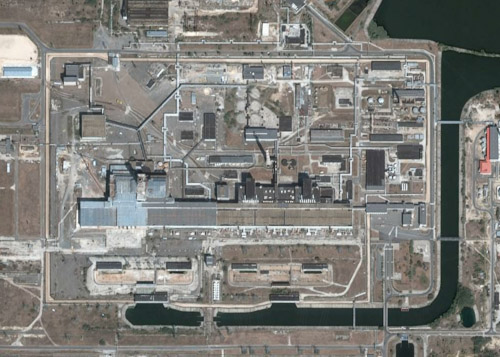
Reactors One to Four at the Chernobyl Nuclear Power Plant. Number four at left was the reactor which exploded seen with the pale grey sarcophagus roof.
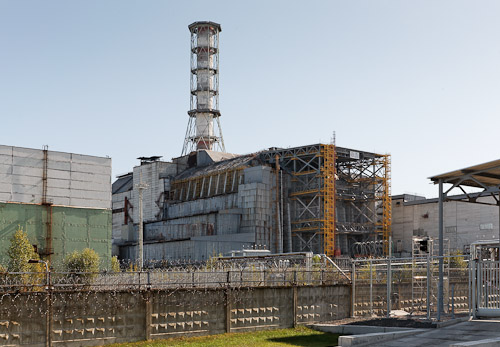
Reactor number 4 in 2007: the yellow buttress is due to subsistence of the sarcophagus structure they are holding up. There were plans to cover the entire building with yet another structure to prevent radiation leakage. Photo © Quintin Lake
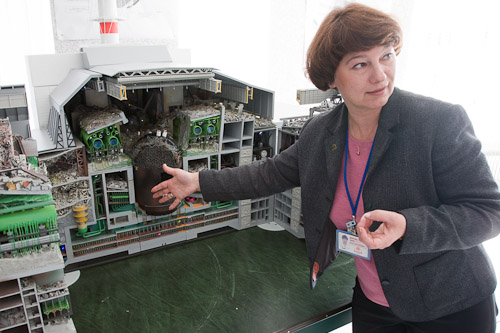
A Ukranian official indicates the fuel rods on a model of Chernobyl Reactor #4 that suffered a catastrophic explosion in 1986. Photo © Quintin Lake

Reactor number 5, which was under construction during the time of the explosion. The cranes date from 1986 when they were abandoned. Photo © Quintin Lake
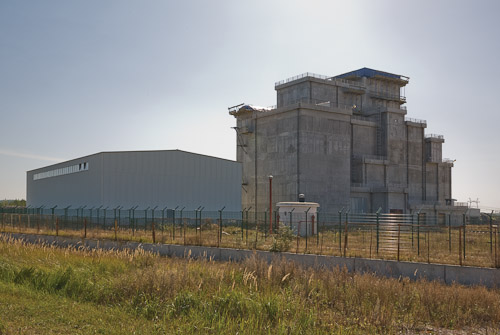
A dry fuel storage facility built in 1999 but later found to be unsuitable for some of the Chernobyl fuel assemblies because they had cracked, soaked up water and changed shape. The facility now stands idle. Photo © Quintin Lake
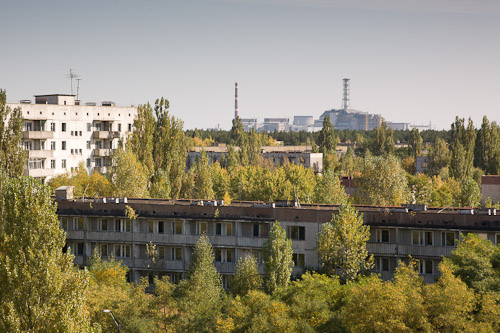
Overgrown abandoned housing in Pripyat ghost town with Reactor #4 Visible in the distance. Photo © Quintin Lake

Concrete entrance sign to Pripyat. Now a memorial, it is surrounded by a steel chain and plastic flowers. Photo © Quintin Lake

Lobby of Hotel Polissia. The checkin desk is in the background. Marble wall cladding has been removed by looters. Photo © Quintin Lake
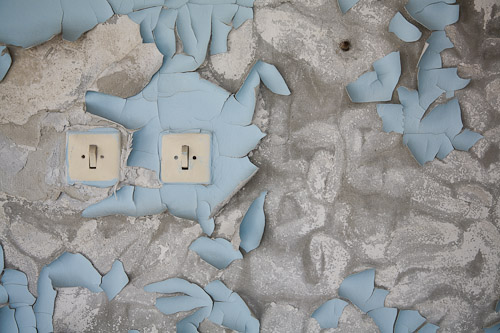
Light switches in a bedroom of Hotel Polissia. Photo © Quintin Lake
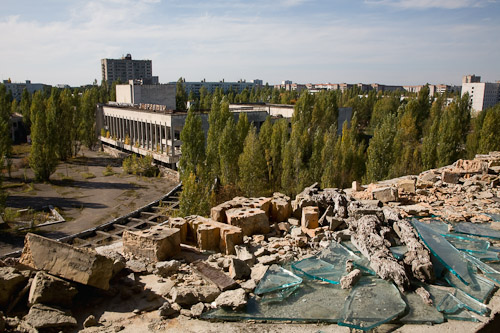
Palace of Culture, central square and apartment blocks viewed from the terrace of hotel Polissia. Photo © Quintin Lake
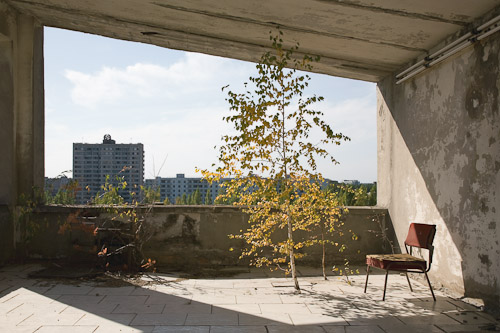
A silver birch tree grows through the floor on the terrace of Hotel Polissia. The hammer and sickle is visible atop the distant apartments. Photo © Quintin Lake
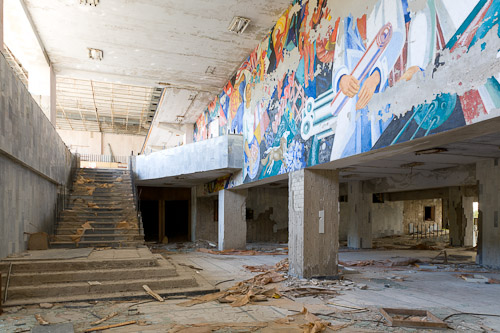
Palace of Culture foyer with Soviet mural. Photo © Quintin Lake

Abandoned dodgems from the fun fair due to open 4 days after the explosion. Photo © Quintin Lake
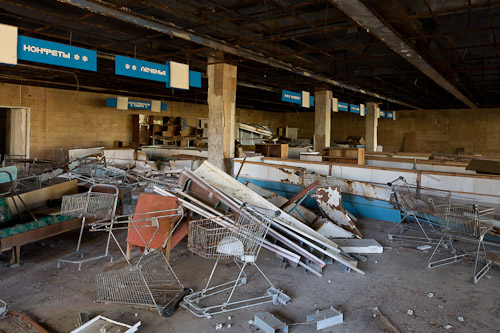
Supermarket interior with abandoned shopping trolleys. Photo © Quintin Lake
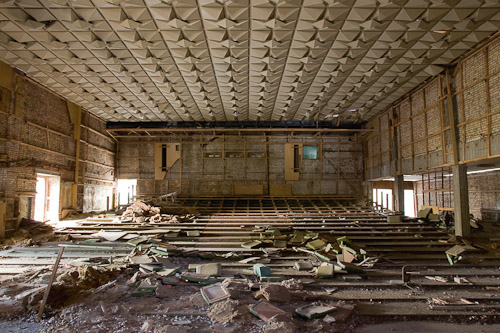
The looted seating area in the Palace of Culture theatre. Photo © Quintin Lake
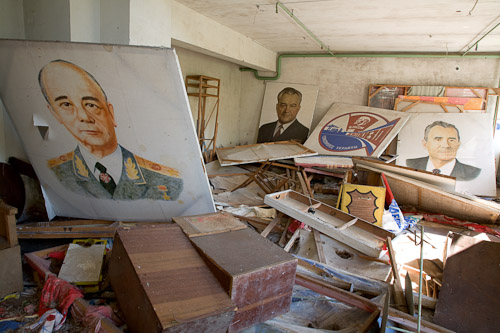
Palace of Culture Theatre prop room with paintings of Lenin and dignitaries. Photo © Quintin Lake

Looted department store next to central square. The floor is covered with decayed ceiling tiles and strip lights. Photo © Quintin Lake
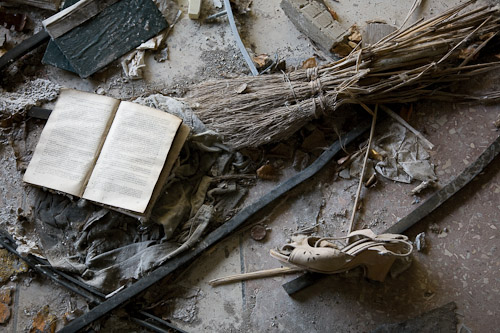
Single shoe, glazing gaskets, book and broom on floor of Department Store. Photo © Quintin Lake
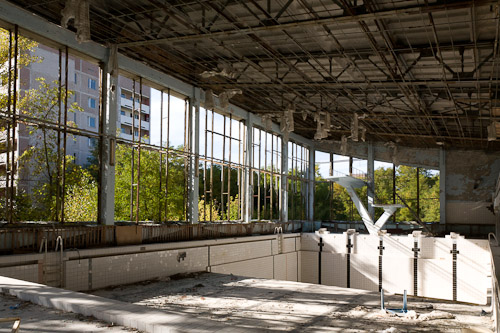
Abandoned Swimming Pool, Pripyat. Photo © Quintin Lake

Light shines across climbing bars and broken basketball hoop in a gymnasium. Photo © Quintin Lake

Abandoned and never used Ferris wheel, Pripyat. The pleasure park was due to open four days after the explosion. Photo © Quintin Lake

Children’s exercise books and broken glass on a classroom floor. Photo © Quintin Lake
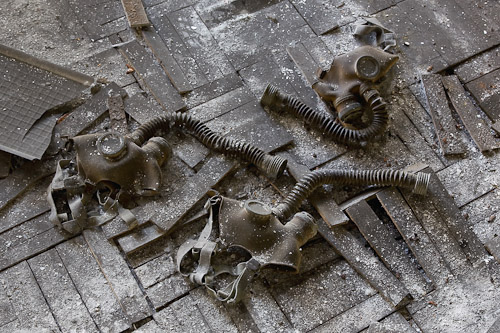
Children’s gas masks, the silver filter elements removed by looters. They had ben issued according to soviet policy in case of nuclear attack from the West. Photo © Quintin Lake
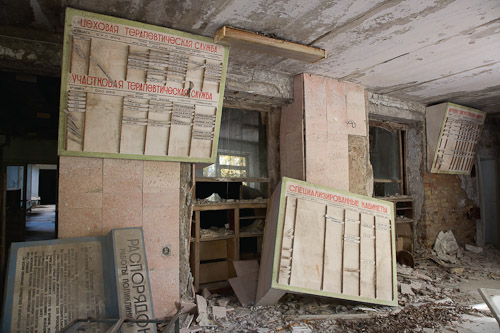
Hospital reception with doctor’s appointment boards. Photo © Quintin Lake
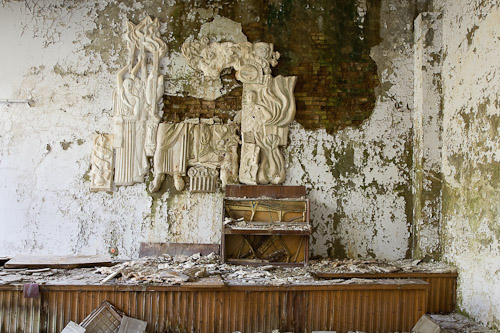
Concert hall with water damaged soviet relief sculpture and piano. Photo © Quintin Lake
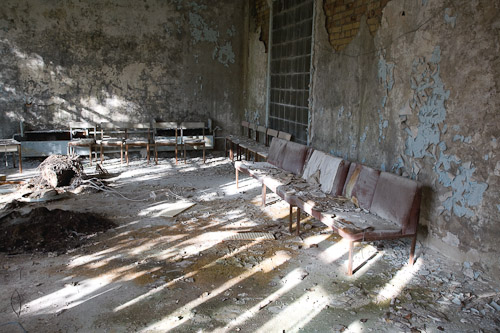
Hospital waiting room, Pripyat. Photo © Quintin Lake

Drawing of Lenin with dead house plant in the hospital. Photo © Quintin Lake

When reactor number four at the Chernobyl Nuclear Power Plant exploded in 1986 the result was the worst nuclear accident in history. Large areas of Ukraine, Belarus, and Russia were severely contaminated, requiring the evacuation and resettlement of over 336,000 people.

Pripyat, 1km from the reactor, was designed as an exemplar of Soviet planning for the 50,000 people who worked at the power plant. A funfair, with bumper cars and Ferris wheel, was due to open two days after the reactor exploded.

These photographs, inspired by Robert Polidori’s earlier images of Chernobyl, were shot in 2007 over 5 hours, apparently the safe period of exposure. Although a Geiger counter was carried in case of localised high emissions, certain areas of vegetation which attract a higher concentration of radiation were avoided.

The physical devastation stems from looting and gradual building collapse, not from the explosion. Over the last ten years people have intruded regularly into the military exclusion zone, stealing everything from irradiated toilet seats to the marble cladding from hotel walls. Photographs of the town capture a memory of three traumas: the invisible radiation, the visible looting and the gradual collapse of a ghost town.

Now with the nuclear disaster at Fukushima Reactor, Japan as a result of the 2011 Tōhoku earth quake and tsunami  these images of Chernobyl have a renewed poignancy.

Selected images from this series been exhibited at the Crane Kalman Gallery in Brighton, the Architectural Association in London, the Royal West of England Academy Autumn Show in Bristol  and the Host Gallery in London. Images from the series are also published in my book Drawing Parallels: Architecture Observed

BUY PRINTS / LICENSE IMAGES of Pripyat and the Chernobyl Nuclear Disaster here >>

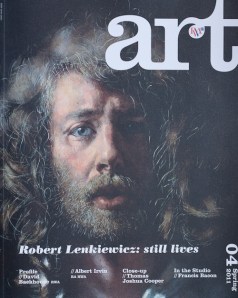
Art Magazine Spring 04 2011

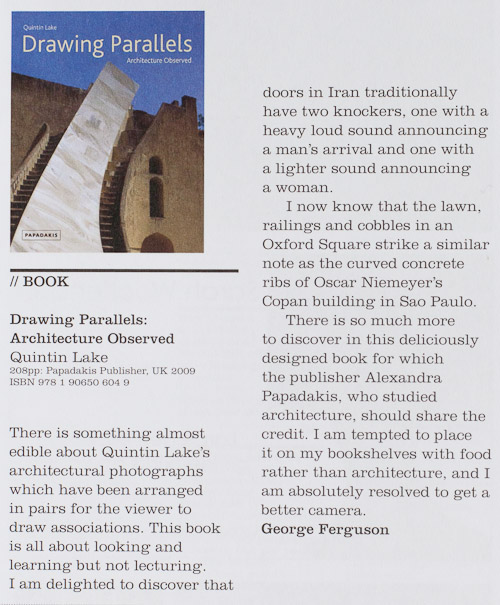
Drawing Parallels: Architecture Observed review by George Ferguson

There is something almost edible about Quintin Lake’s Architectural Photographs which have been arranged in pairs for the viewer to draw associations. This book is all about looking and learning but not lecturing. I am delighted to discover that doors in Iran traditionally have two knockers, one with a heavy loud sound announcing a man’s arrival and one with a lighter sound announcing a woman.

I now know that the lawn, railing and cobbles in an Oxford Square strike similar note as the curved concrete ribs of Oscar Niemeyer’s Copan building in Sao Paulo.

There is much more to discover in this deliciously designed book for which the publisher Alexandra Papadakis, who studied architecture, should share the credit. I am tempted to place it on my bookshelves with food rather than architecture and I am absolutely resolved to get a better Camera. George Ferguson

Buy Drawing Parallels from Papadakis Publisher here

Book cover: The Last of the Borneo Rainforest by Quintin Lake

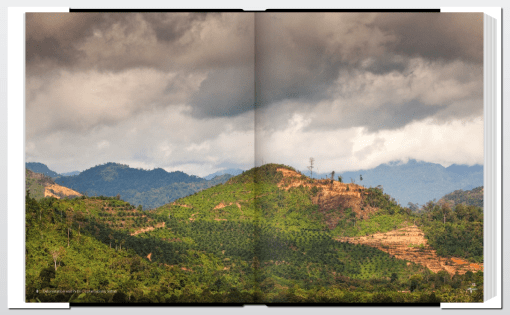
Deforestation in Sabah for Palm Oil plantations

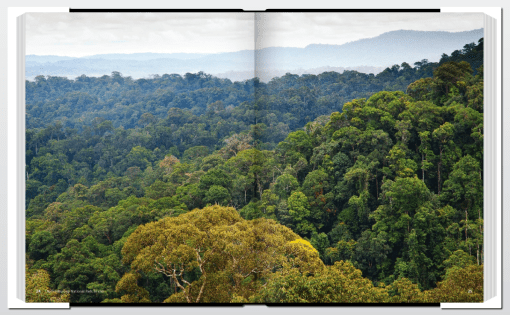
Virgin rainforest in Ulu Temburong, Brunei

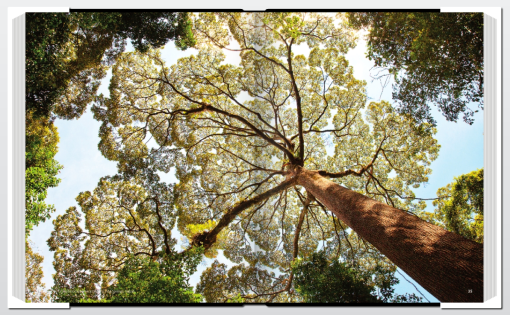
Rainforest canopy in Sabah, Borneo

A photostory of deforestation and Palm Oil plantations contrasted with the wildlife of Sabah and Brunei. Featuring Sepilok, Kinabalu National Park, Danum Valley, Kinabatangan River, Peradayan and Ulu Temburong.

Binding: Hardback, 146 pages
Format: 20 × 25 cm, Full page photographs in colour throughout

Preview and order the book here > >

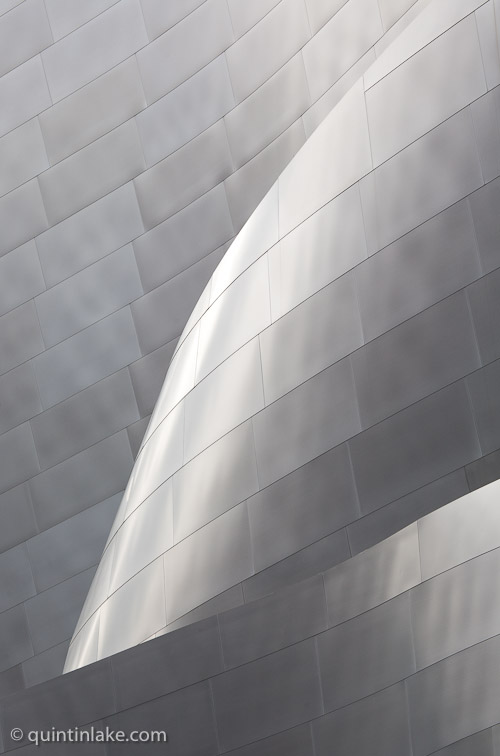
Facade I. Detail of the stainless steel facade of the Walt Disney Concert Hall, LA. Photo: Quintin Lake

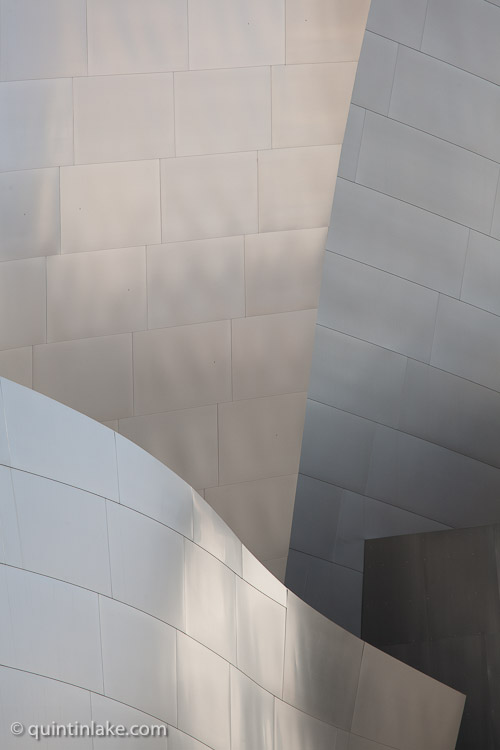
Facade II. Detail of the stainless steel facade of the Walt Disney Concert Hall, LA. Photo: Quintin Lake

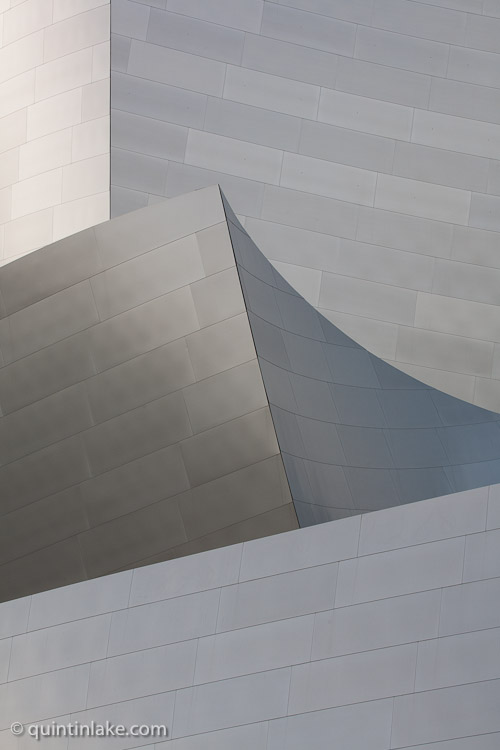
Facade III. Detail of the stainless steel facade of the Walt Disney Concert Hall, LA. Photo: Quintin Lake

The subtle abstract quality of the matte stainless steel panels as they catch the light is what struck me the most about Frank Gehry’s celebrated and much photographed Deconstructivist Walt Disney Concert Hall in Los Angeles built in 2003. Originally, one portion of the building featured highly polished panels; however, these were dulled in 2005 due to heat reflection problems in nearby buildings. See images of the Gehry House, LA from 1978 where his experiments with deconstructivism in architecture began.

See more photos of details, facade elevations and complete views of the building here >>

Travel Photographer of the Year

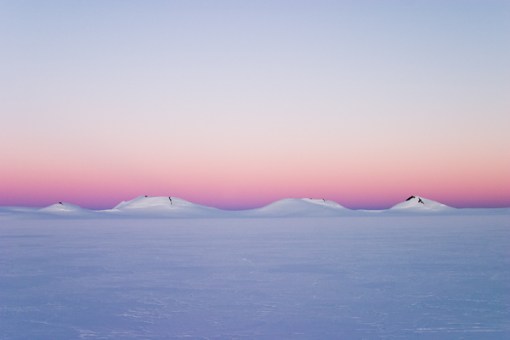
Arctic Horizon. Travel Photographer of the Year 2010 –  Portfolio Winner. Photo: © Quintin Lake

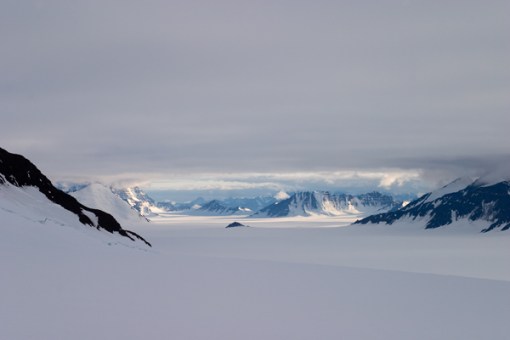
Midnight Mountains. Travel Photographer of the Year 2010 –  Portfolio Winner. Photo: © Quintin Lake

Light & Ice. Travel Photographer of the Year 2010 –  Portfolio Winner. Photo: © Quintin Lake

Silent Light. Light & Ice.Travel Photographer of the Year 2010 –  Portfolio Winner. Photo: © Quintin Lake

I’m delighted to announce that I have won the Amazing Places Portfolio Category of the Travel Photographer of the Year 2010. This prestigious international competition, which attracts thousands of applicants, involves submitting images online then if shortlisted sending fine art prints for final judging. The Portfolio category is based on a series of four images.

STORY BEHIND THE PORTFOLIO

These images were taken during Anglo-Scottish East Greenland expedition in 2006 which was a month long ski journey involving pulling sleds, undertaken with three friends with the aim of climbing new peaks in an unexplored area of East Greenland. The expedition succeeded in 16 first ascents but the real discovery for me was the otherworldly light of the Arctic cased by the midnight sun and the interplay of the palette of pastel colours with the almost-not-there landscape.

Much of the month was either bright blue skies or white clouds – of little photographic interest – but the images in the portfolio were of the sudden moments of drama that punctuated these conditions. For example, the primarily grey photograph, depicting the horizon of light  was taken when we were tent bound for three days on the icecap and the light appeared momentarily just before the storm closed in again.

ANGLO-SCOTTISH EAST GREENLAND EXPEDITION INFO

  • A technical account of the Expedition in the 2009 American Alpine Journal
  • The Expedition Report. Which is also available to view at: The Royal Geographical Society, The British Mountaineering council, Tangent Expeditions, The Mountaineering Council of Scotland, The Alpine Club, The Mount Everest Foundation, Arctic Club, Scottish Arctic Club, and the Danish Polar Centre

BUY FINE ART PRINTS

Prints are available in two sizes:

  • Signed A2 giclee print on cotton fine art paper £295.00 (edition of 25)
  • Signed 90x60cm Lightjet on Aluminium float frame £1200.00 (edition of 7) see example

To order prints either contact me direct of order online here

Concert hall, Pripyat

Concert hall, Pripyat, Chernobyl. Photo : Quintin Lake

This photograph, Concert Hall From the series “Pripyat: 21 years after Chernobyl” is one of 50 works to receive a commendation in the Artwork & Photography category of the Aesthetica Creative Works Competition 2010. The competition received over 4,000 entries from across the world.

BUY PRINT of Pripyat 21 Years after Chernobyl (The Concert Hall), Giclee Print, 50x33cm, Edition of 25 + 1 A/P

The print has previously been on shown at the Crane Kalman Gallery in Brighton, the Architectural Association in London, the Royal West of England Academy Autumn Show in Bristol  and the Host Gallery in London.

Photography © Quintin Lake, 2010

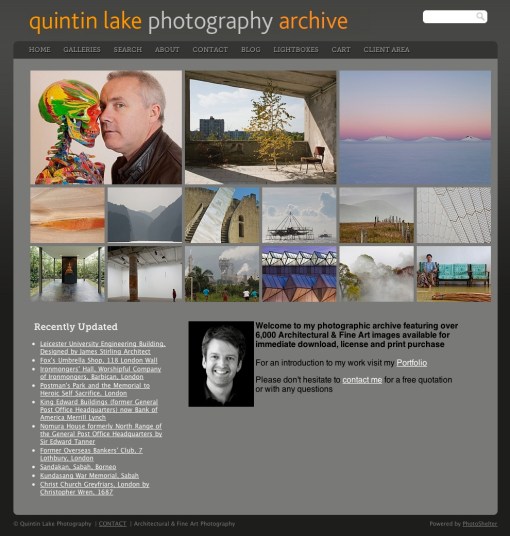
Updated: Image Archive featuring over 6,000 Architectural & Fine Art images available for immediate download, license and print purchase

I’ve just completed a major overhaul to my archive website which now contains over 6,000 of my Architectural & Fine Art photographs for sale as prints or download. The website is based on Photoshelter and is used to deliver images to my clients securely, archive my work and integrate commerce. Hope you like it!

Vist the new site here >>

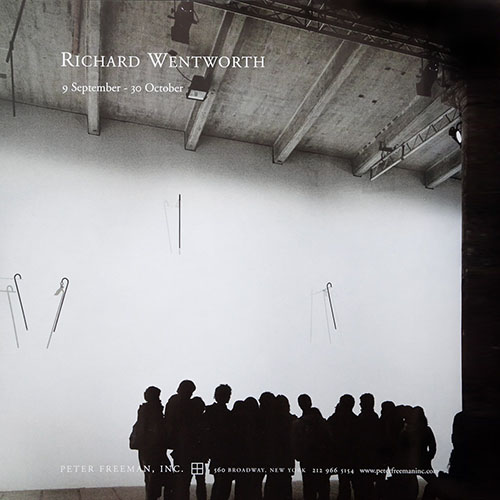
An image from my photoshoot of Richard Wentworth’s “Untitled’ 2009 installation at the Venice Biennale is featured in the September issue of Artforum as a full page advert for Wentworth’s Exhibition at Peter Freeman Inc Gallery, New York.

Artforum International Magazine September 2010

Advert for Richard Wentworth's Exhibition at Peter Freeman Inc Gallery, New York in Artforum (Photography © Quintin Lake)

The exhibition at Peter Freeman Inc, New York runs from 9 September – 30 October 2010

View photographs of Richard Wentworth’s  Walking sticks and Hanging Books installations from  the 53rd Venice Biennale at the Arsenale here

Photography © Quintin Lake, 2009